
What’s Happening
A loud grinding noise when your gate moves almost always means metal-on-metal contact somewhere in the drive system – worn rollers, dry or damaged hinges, a failing gate motor gear, or debris caught in the track. It is not normal, and it will not get better on its own. The grinding you hear today is the gate telling you something is wearing down, and every cycle it runs is adding to the damage.
Gates grind when the parts that are supposed to slide or rotate smoothly can no longer do it. Lubrication breaks down, bearings wear out, tracks collect grit, and gears that were molded to tight tolerances start to slip. The sound feels sudden, but the wear behind it usually built up over months. Catching it now – before a hinge cracks, a gear strips completely, or a roller locks up mid-swing – is the difference between a straightforward repair and a much larger one.
Why It Happens
Dry or Damaged Hinges
Hinges are the most common source of gate grinding, and they’re also the easiest to diagnose. Stand close to the gate while someone opens it slowly. If the grinding is loudest right at the hinge point and you can see rust, flaking metal, or a gap where the barrel meets the pin, the hinge is either bone dry or worn past its useful life. A hinge that hasn’t been lubricated in a year or two will sound like gravel in a coffee grinder.
Worn or Seized Rollers and Track
On sliding gates, rubber or nylon rollers ride inside a track along the ground. Over time, rollers crack, flatten, or lose their bearings entirely and begin to drag. If the grinding follows a scraping rhythm as the gate travels – or if you can see the roller sitting lopsided in the channel – that’s the problem. A track packed with gravel, leaves, or debris from seasonal weather will produce the same sound even when the rollers themselves are fine.
Failing Gate Motor or Opener Gear
Gate motors contain drive gears, worm gears, or chain sprockets that wear down over years of daily cycles. When one of these starts to go, you’ll hear a grinding or growling that comes from the motor housing itself rather than from a hinge or roller. The gate may also hesitate, jerk, or slow mid-travel. If the noise only starts when the motor engages and stops the moment the gate stops moving, the motor’s internal mechanism is the likely source. This is not a lubrication fix – a worn gear needs to be replaced by a trained technician.
Loose or Misaligned Hardware
A gate that has shifted out of alignment – because of ground movement, a post that has heaved, or mounting hardware that has worked itself loose over years of use – will grind wherever the gate frame drags against a stop, a post, or the ground. Look at the gap between your gate and its frame when it’s fully closed. If the gap is uneven, wider at the top than the bottom or vice versa, the gate has moved. The grinding will tend to be irregular and positional, louder in certain spots on the swing rather than throughout the whole travel.
What to Do Right Now
- Stop running the gate. Every cycle in this condition wears the damaged component further. If you can leave it in a closed or open position and simply not use the opener until a technician arrives, do that. A gate that grinds through fifty more cycles may turn a repair into a replacement.
- Take a short video on your phone. Walk alongside the gate while it moves and record where the sound is loudest. A 20-second clip showing the grinding in real time tells a technician more than any description, and it helps identify the source before they even pull up.
- Look at the hinges, rollers, and track from a safe distance. You are looking for visible rust, cracks, misalignment, or debris – not touching or adjusting anything. Note what you see so you can describe it on the call.
- Do not oil the motor housing or apply lubricant to electrical components. Spraying general lubricant into a gate motor can cause additional damage. Hinges and external metal parts are fair game for a careful application of a dry or silicone-based spray, but if you’re not certain what you’re spraying, wait for the technician.
- If your gate has a gate motor connected to a power source, do not attempt to open the housing. Gate motor components can carry live electrical current. Leave the housing sealed, note the brand name and model number visible on the outside if you can find it, and let a trained technician handle what’s inside.
How We Fix It
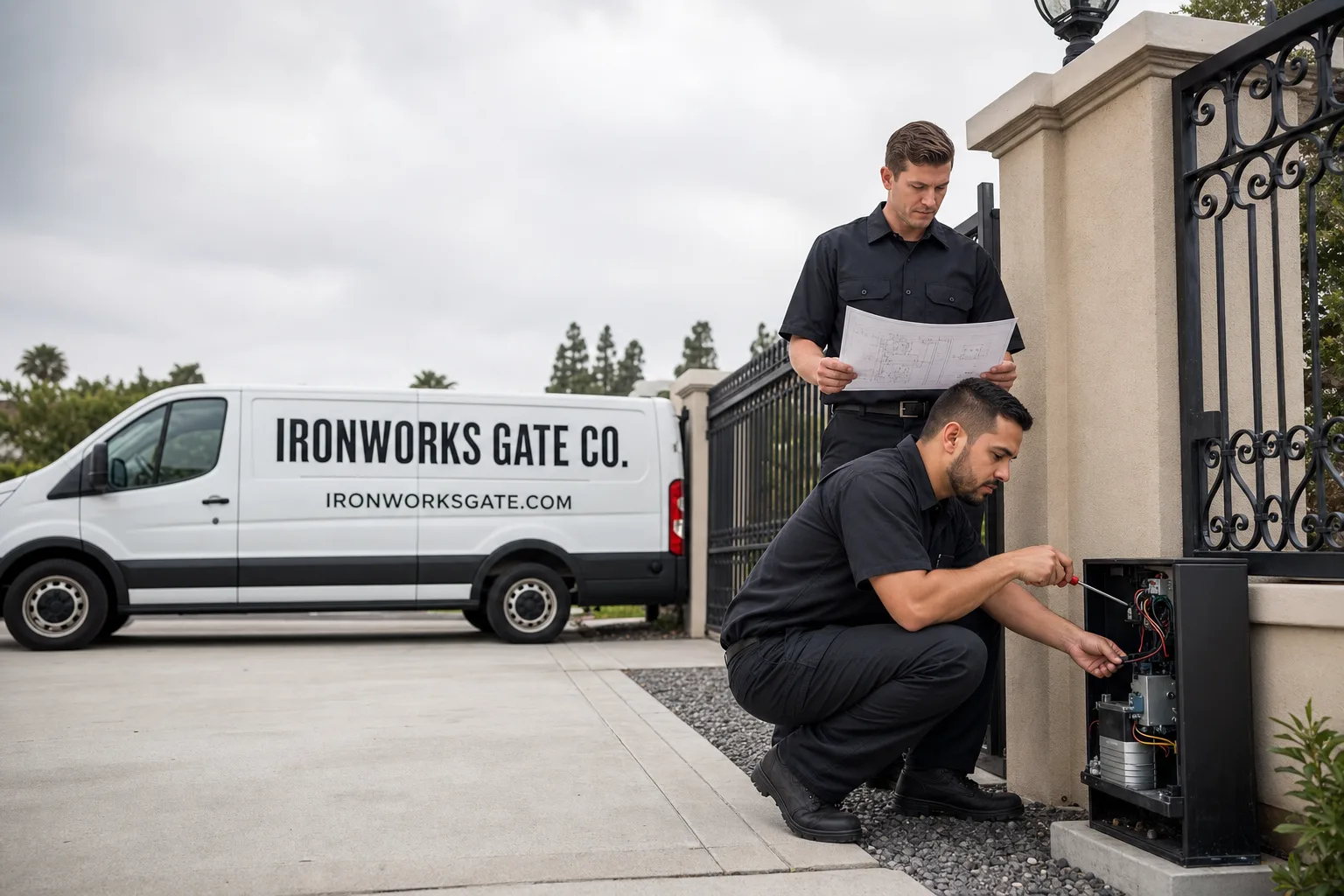
When your local Ironworks Gate Co. team arrives, the technician starts with a full mechanical inspection – hinges, rollers, track, hardware alignment, and the motor – before anything is quoted or touched. The grinding source is identified and shown to you directly. You receive a written estimate with the price for the repair spelled out before a single bolt is turned. No surprises on the bill.
Most grinding repairs fall under our Gate Repair service. If the motor or opener drive mechanism is the culprit, that work is handled under Gate Motor and Opener service. Our technicians are trained and equipped on nine gate-automation brands – LiftMaster, FAAC, BFT, Linear, Viking, Ghost Controls, DoorKing, Elite, and Mighty Mule – so whatever is on your driveway, the correct parts and the correct fix are on the truck.
Most grinding repairs are completed in a single visit. Every completed job is covered by the 90-Day Done Right Promise – the Keystone Standard, in writing, no paperwork, no arguing. If it’s not right after we leave, we come back and make it right.
Frequently Asked Questions
A grinding gate is a gate that is actively damaging itself every time it runs, so waiting is not free – it is just paying later instead of now. In most cases it is not an immediate physical hazard, but a gate that seizes mid-swing, drops a cracked hinge, or locks up on a track can create a real problem fast. The sooner it’s looked at, the better the repair options. Call (833) 754-7503 and a live person will answer right now.
Yes. A live person answers at (833) 754-7503 around the clock, every day of the week – not a voicemail and not an answering service. Your local Ironworks Gate Co. team schedules urgent calls and works to get a technician to you as quickly as the day allows. Call now and we’ll get you on the schedule.
The technician will tell you exactly what is wrong and what the repair involves before any work starts. Many grinding motor issues – stripped gears, worn drive components – are repaired rather than replaced, depending on the age and condition of the unit. You’ll have a written estimate covering both options if replacement is on the table, and the decision is entirely yours.
Every job is priced from a free written estimate specific to your gate, your hardware, and the condition the technician finds on arrival. There is no way to quote grinding repairs at a flat rate because the source of the grinding determines the work. What we can tell you is that your local Ironworks team will give you the price in writing, upfront, before anything starts – and if your repair comes to more than $250, the current $50 Off Any Repair Over $250 offer applies. Call (833) 754-7503 to get a free estimate scheduled.
Get It Fixed
Call (833) 754-7503 right now – a live person answers 24 hours a day, 7 days a week. Your local Ironworks Gate Co. team will schedule a visit, give you a free written estimate on arrival, and get your gate running quietly again. The 90-Day Done Right Promise backs every repair.
Written by Victor Salinas, Owner at Ironworks Gate Co., proudly serving local communities since 1984.