
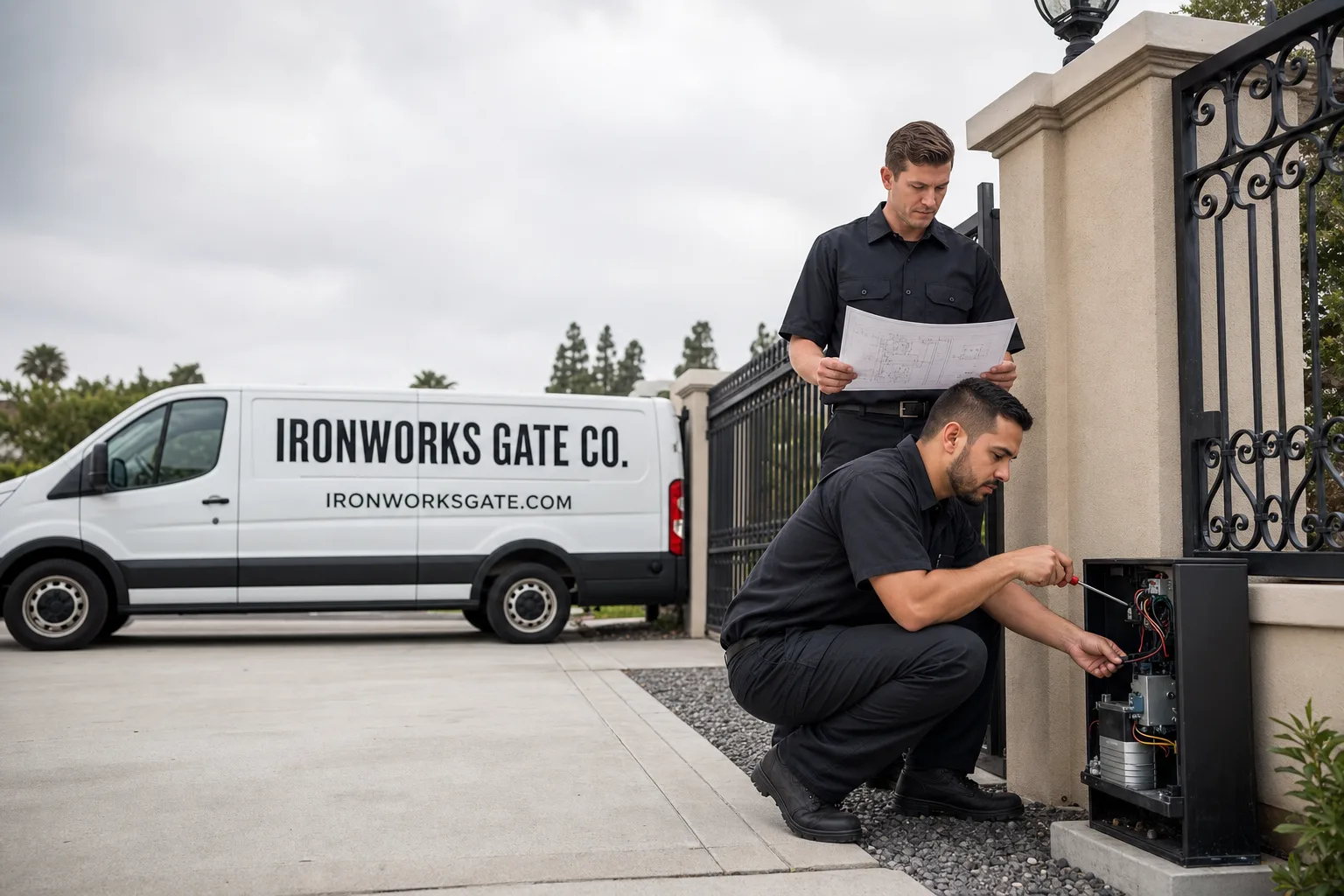
What’s Happening
A gate that won’t open or close is almost always caused by one of four things: a failed motor or operator, a broken or damaged hinge, a dead or misconfigured access control system, or a physical obstruction the gate can’t push past. In most cases, a trained technician can pinpoint the cause on a single visit and have it working the same day.
Gates fail quietly at first. A motor that’s been struggling for months finally refuses to cycle. A hinge that shifted a quarter-inch over a winter makes the gate bind just enough to trip the safety reverse. Or the power supply drops out and nothing moves at all. The symptom looks the same from the driveway – nothing happens when you press the button – but the fix depends entirely on which of those causes is actually at work. That’s what a proper diagnosis is for, and it’s the first thing your local Ironworks Gate Co. team does when they arrive.
Why It Happens
1. Motor or Operator Failure
The gate operator is the most common single point of failure on any automated gate. Capacitors burn out, control boards fail, and motors wear through their duty cycles – especially on gates that open and close dozens of times a day. If you press the button and hear nothing at all, or you hear a faint hum or click without any movement, the operator is the first place to look. Check whether the operator’s indicator lights are on; a completely dark control box usually means a power problem, while a lit board with no movement points to a mechanical or board-level fault inside the unit.
2. Broken or Damaged Hinge
On swing gates especially, a failing hinge will let the gate sag just enough that it drags on the ground or catches the post before it can fully travel. You’ll often hear a scraping or grinding sound as the gate tries to move, and you may notice the gate hanging at a slight angle when it’s at rest. Weld-cracked hinges and worn pivot pins are common on gates that have been in service ten years or more, particularly in climates where freeze-thaw cycles work the metal over every winter. Don’t force the gate through this – continuing to run the motor against a bound hinge puts strain on the operator that can turn a hinge repair into a motor replacement.
3. Access Control or Wiring Problem
If the gate physically looks level, the motor sounds like it wants to run, but nothing happens when you use the keypad, remote, or intercom, the problem is likely in the access control system or the wiring between it and the operator. A corroded wire connection, a failed receiver board, or a keypad that’s lost its programming can all produce the same symptom: gate sits still, no obvious mechanical reason. Try the gate’s manual release if you have one – if the gate swings freely by hand, the mechanical side is fine and the fault lives in the electronics.
4. Obstruction, Track Damage, or Limit Setting
Slide gates run on a track that collects debris, and a rock, a branch, or a buildup of dirt can stop the gate mid-travel or prevent it from completing its cycle. On both swing and slide gates, the operator’s travel limits – the programmed points where it knows to stop – can drift over time and cause the gate to stop short or stall before it reaches the open or closed position. Walk the length of the track or the swing path and look for anything visible. If the path looks clear but the gate still stalls at a consistent point, a limit or sensitivity adjustment is likely what’s needed, and that’s a technician setting, not a homeowner adjustment.
What to Do Right Now
- Stop cycling the operator. If the gate is bound, stalled, or making unusual noises, running the motor repeatedly against the resistance causes additional damage. One or two attempts to confirm the problem is plenty – then leave it alone.
- Check the obvious power sources first. Confirm the operator is plugged in or that the breaker feeding it hasn’t tripped. Solar-powered gate systems can lose charge after several overcast days – check whether the solar panel indicator shows a charge. This takes thirty seconds and occasionally solves the problem entirely.
- Use the manual release if you need the gate open. Most gate operators have a manual disconnect lever or key-release so you can operate the gate by hand during a power outage or mechanical failure. Your operator’s manual shows where it is. Use this to clear a blocked driveway while you wait for service – but do not attempt to move a gate that is visibly off its track or has a broken hinge, as the panel can fall.
- Photograph what you see before touching anything. A clear photo of the operator’s indicator lights, the hinge area, the track, and the gate’s position helps your technician arrive with the right parts. Text or email it to the scheduling team when you call.
- Do not attempt to repair springs, cables, or wiring yourself. Gate operators involve electrical components that can store charge even when unpowered. Physical gate springs and counterweights carry serious tension. These are components where a mistake causes injury, not just a repeat service call. If you suspect the problem is inside the operator housing or involves any spring or cable assembly, stop and call – this is genuinely the kind of work where training and the right tools matter.
How We Fix It
When your local Ironworks Gate Co. technician arrives, the first thing they do is a complete diagnostic – operator, hinges, track or pivot hardware, access control, and wiring – before any repair work starts. We’ve been doing this since 1984, and the one thing experience teaches you is that the visible symptom and the actual cause aren’t always the same thing. A thorough look at the whole system takes fifteen or twenty minutes and it’s the reason most of our jobs are finished in a single visit.
Once the cause is confirmed, you get a written estimate with the price for that specific repair settled before a single bolt is turned. No surprises on the bill. Our technicians are trained and equipped to service nine operator brands – LiftMaster, FAAC, BFT, Linear, Viking, Ghost Controls, DoorKing, Elite, and Mighty Mule – so the correct fix gets made on that visit, whatever is sitting on your driveway. The work is covered by our 90-Day Done Right Promise: if it’s not right after we leave, we come back and make it right, in writing, no arguing, no paperwork. That’s the Keystone Standard, and it applies to every job we do.
Depending on what’s found, the resolution typically falls under our Gate Repair or Gate Motor and Opener services, and in cases where a hinge or structural weld has failed, our Gate Parts and Welding capability means we’re not sending you to a separate shop.
Frequently Asked Questions
It depends on how the gate is failing, and that’s not a question worth guessing at. A gate stuck in the closed position can block emergency vehicle access to your property – that’s a genuine safety concern, not a hypothetical one. A gate stuck open leaves your property unsecured. Either way, “wait and see” is rarely the right call. Call (833) 754-7503 and let us help you assess whether it needs to be looked at today.
Our phones are answered by a live person 24 hours a day, 7 days a week – not a voicemail, not an answering service. When you call, you’ll speak with someone right then who can tell you what availability looks like and get your local Ironworks Gate Co. team scheduled. We can’t promise a specific response time on this page because that depends on your location and current schedule, but calling (833) 754-7503 gets you a straight answer immediately.
Gates rarely fail without warning; they usually fail after weeks or months of warning signs that are easy to miss – slower travel times, hesitation at the start of a cycle, a faint grinding that becomes background noise. When a motor, hinge, or control board finally gives out, it often looks sudden from the outside. The good news is that a problem that built up gradually is usually a straightforward fix once it’s properly diagnosed.
We don’t quote prices before we see the gate – the right price depends on what’s actually wrong, and quoting a number before the diagnosis is how homeowners end up with surprises on the bill. What we do promise is a written estimate, in full, before any work begins. You’ll know exactly what it costs before we start. And if you already have a written estimate from another company, our Free Second Opinion offer means we’ll review it at no charge. Call (833) 754-7503 to schedule.
Get It Fixed
Call (833) 754-7503 – a live person picks up, day or night, seven days a week. Your local Ironworks Gate Co. team will schedule a diagnostic visit, give you a written estimate before any work starts, and back every repair with our 90-Day Done Right Promise.
Written by Victor Salinas, Owner at Ironworks Gate Co., serving local communities since 1984.