
Gate Stopped Working After a Power Outage
If your gate stopped working after a power outage, the motor’s control board lost power and may not have recovered on its own. Most gates need a manual reset or a board reset after an outage, and some have battery backup units that fail silently over time. In the majority of cases, this is fixable in a single visit.
A power outage is rarely the whole story. What usually happens is this: the outage cuts power to the operator, and when power comes back, something in the control board, the surge protection circuit, or the backup battery doesn’t recover cleanly. The gate sits there looking fine, the light on the motor may even be on, and nothing moves. It’s frustrating, but it’s also one of the more straightforward things a trained gate technician diagnoses and clears. The tricky part is knowing which of the three or four possible causes you’re actually dealing with – because the fix is different for each one.
Why It Happens
The Control Board Didn’t Reset
Gate operators – especially models from LiftMaster, FAAC, and BFT – have microprocessor control boards that sometimes lock up when power is cut abruptly. When power returns, the board can sit in a fault state rather than booting normally. If your gate shows no response at all but the motor’s status light is solid or blinking in an unfamiliar pattern, a locked board is the most likely explanation. Some boards will clear with a manual power cycle; others hold a fault code that requires a technician’s programmer to clear.
A Power Surge Damaged the Board or Receiver
Outages rarely end cleanly. Power often comes back with a brief surge, and that surge can blow a fuse on the control board, damage the receiver module, or take out a logic board entirely. If your gate worked perfectly before the outage and does absolutely nothing now – no beep, no click, no movement – a surge-related component failure is a serious possibility. You may see a small burnt smell near the motor housing, or a fuse holder inside the cabinet that looks discolored. Do not probe the board yourself; the capacitors inside gate operators can hold a charge even when the unit appears dead.
The Battery Backup Drained or Failed
Many gate operators include a sealed lead-acid battery backup designed to run the gate through short outages. These batteries have a limited service life, and an outage is often the event that exposes a battery that was already near the end of its useful span. If your gate worked during the outage but stopped after power returned, or if it ran sluggishly and then quit, the battery may have discharged completely and is now blocking the system from running on AC power. A battery in this condition sometimes trips a low-voltage protection circuit that keeps the whole operator offline until the battery is replaced.
The Gate Lost Its Limit or Safety Settings
Some operators – particularly older Viking and Linear units, and a few Ghost Controls models – store their travel limits and obstruction sensitivity settings in volatile memory that can be scrambled when power drops without warning. The gate may power on, hum, and then stop partway through travel, or it may refuse to move at all because the controller doesn’t have reliable travel data. If your gate moves a few inches and then reverses or stops, this is worth suspecting. Reprogramming the limits is a straightforward technician task but is not something to attempt without the model-specific procedure in hand, because incorrect limit settings on a heavy gate can create a genuine pinch or crush hazard.
What to Do Right Now
- Check whether you have power at the operator. Confirm the motor cabinet has power – look for any indicator light. If there is no light at all, check the circuit breaker or GFCI outlet serving the gate before assuming the operator is damaged.
- Do a single power cycle. Turn off the breaker serving the gate, wait sixty seconds, and turn it back on. This clears many control board lockups without any other intervention. If the gate starts working normally, you’re done for now – but it’s worth scheduling a tune-up to check for underlying issues before the next outage.
- Put the gate in manual release mode. Most gate operators have a manual release handle or lever that lets you push the gate by hand. Consult your operator’s label or door for the release location. This keeps your property accessible while you wait for service. Do not force the gate if it feels mechanically bound – stop and call.
- Do not repeatedly trigger the open/close button. If something is wrong with the board or a limit setting, cycling the gate repeatedly can stress the motor and worsen the underlying fault. One test cycle is reasonable. More than that does more harm than good.
- Photograph the status lights and any error codes. Before the technician arrives, take a clear photo of the motor cabinet’s indicator panel. Those blinking codes are diagnostic information, and they sometimes clear themselves before anyone shows up. A photo preserves that data.
How We Fix It
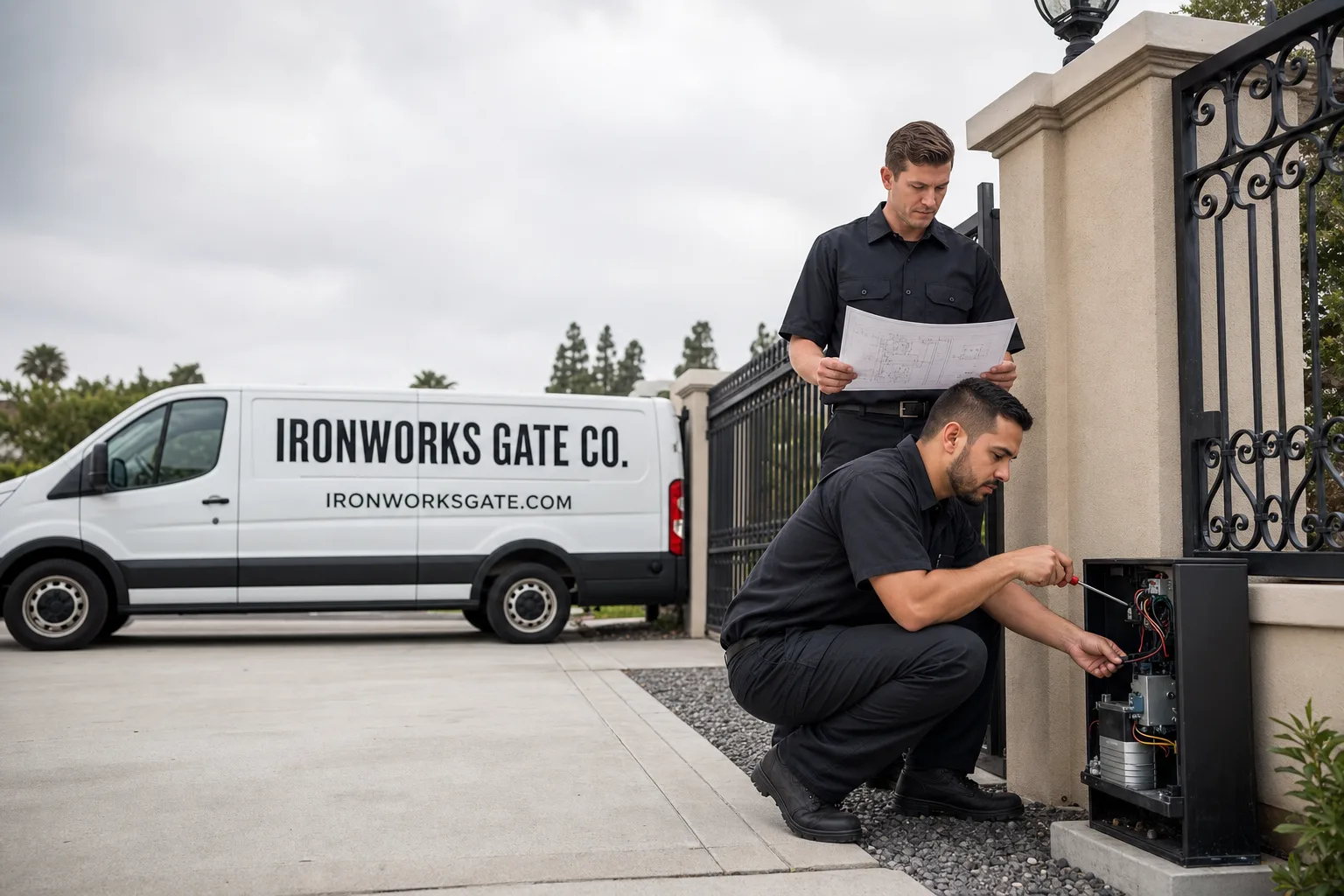
When your local Ironworks Gate Co. team arrives, the technician starts at the control board – reading any stored fault codes, checking the fuse bank, and testing the battery under load. That last part matters: a battery can show a voltage reading that looks acceptable while failing the moment it’s asked to do real work. From there, the technician checks the receiver, the surge suppressor if one is installed, and the logic board itself for heat or burn damage.
If it’s a board reset or a battery swap, most operators are back online the same visit. If a control board has been damaged by a surge, replacement boards for LiftMaster, FAAC, BFT, Linear, Viking, Ghost Controls, DoorKing, Elite, and Mighty Mule systems are part of what we carry. Before anything is replaced, you get a written estimate – the exact price, in writing, settled before a single bolt turns. No surprises on the bill. The work is covered by our 90-Day Done Right Promise: if something isn’t right within ninety days, we come back and make it right. No paperwork, no arguing. That’s the Keystone Standard, and it applies to every job.
Frequently Asked Questions
A gate stuck in the open position is a security concern, and a gate stuck closed is an access problem – neither is something you want to leave for long. The more pressing safety issue is if the gate is stuck mid-travel or moves unpredictably, which can create a crush hazard for vehicles and people. If the gate is behaving erratically – moving on its own, reversing without reason, or closing faster than normal – stop using it and call (833) 754-7503 right away.
A live person answers our phone around the clock, every day of the week – not a voicemail, not an answering service. Call (833) 754-7503 and your local Ironworks Gate Co. team will get a technician scheduled. Most gate repairs are completed in a single visit, and we’ll tell you exactly when to expect us.
Possibly, yes – if the root cause isn’t addressed. A battery backup that’s past its service life will fail again. A control board without surge protection will remain vulnerable. During the service visit, the technician will note any components that are working now but are likely to cause the same problem on the next outage, so you can make a clear decision about whether to address them while someone is already on-site.
Not always. In many cases, only a fuse, a receiver module, or a logic board needs replacing – not the entire operator. A technician can tell you within the first part of the visit what’s repairable and what isn’t, and you’ll get that answer in writing before any work begins. If a full replacement makes more sense, that will be spelled out clearly with no pressure. Call (833) 754-7503 for a free second opinion if you’ve already received a written estimate from another company.
Get It Fixed
Call (833) 754-7503 any time – day or night, a real person answers. Your local Ironworks Gate Co. team will diagnose the problem, give you a written estimate before any work starts, and back the repair with our 90-Day Done Right Promise. We’ll be there when we say.
Written by Victor Salinas, Owner at Ironworks Gate Co., serving local communities since 1984.