
Gate Repair in Washington, DC
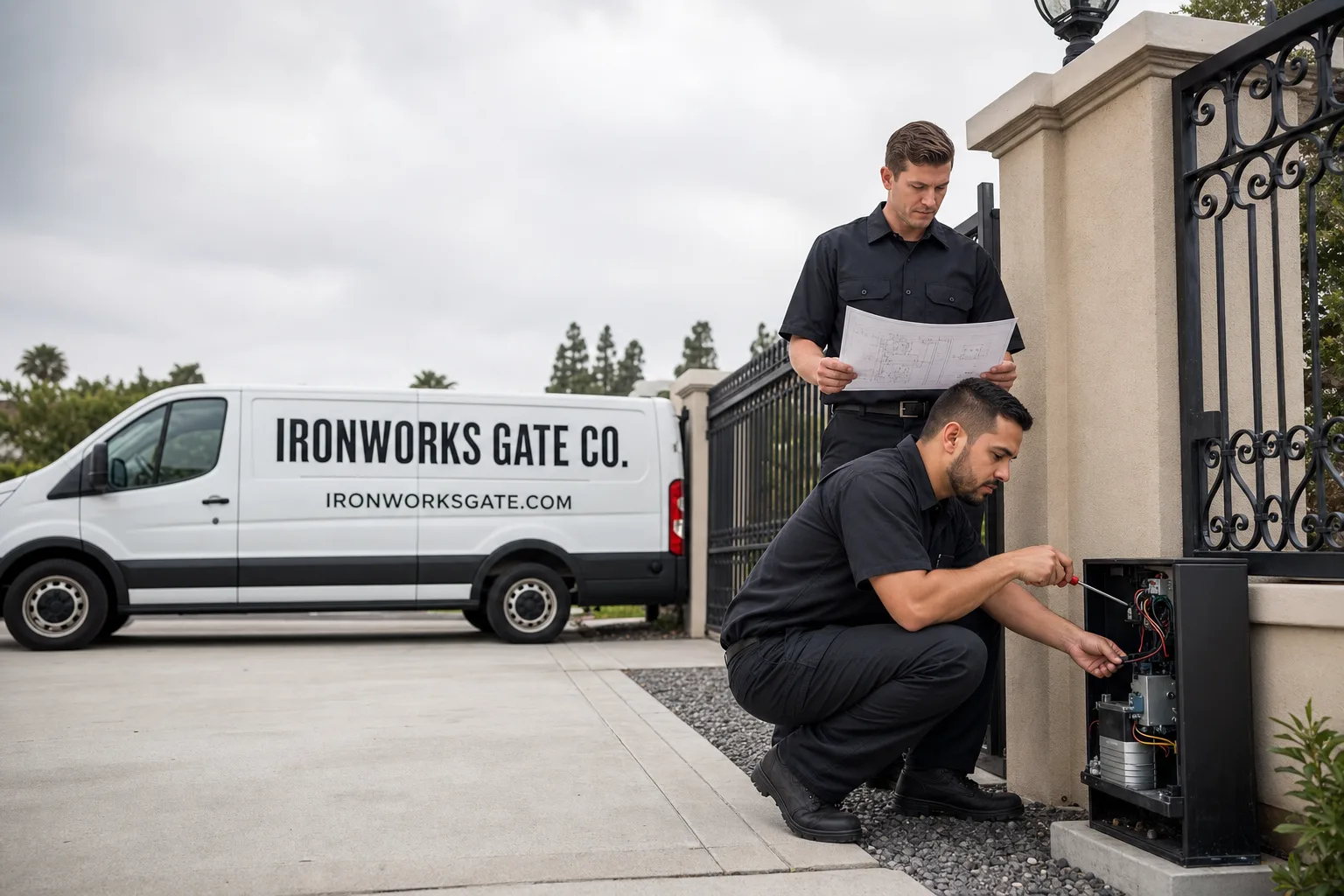
Gate repair in Washington, DC typically runs $180-$650 depending on the damage, and most hinge and weld repairs are completed in a single visit. What makes Washington different is the housing stock: the city’s Victorian and Edwardian rowhouses came standard with ornamental iron gates that are now 80-130 years old, and many sit within Historic Districts where repair is legally preferred over replacement. Call (833) 754-7503 and a live person answers, 24 hours a day, 7 days a week.
Why Washington Homes Are Different
Washington’s humid subtropical climate delivers roughly 40 inches of rain per year plus a genuine freeze-thaw cycle each winter. That combination is brutal on century-old iron: moisture penetrates rust pockets and existing weld cracks, then expands when temperatures drop and splits the metal wider. By spring, we’re fielding dozens of calls from Capitol Hill and Shaw where gates that closed in October now drag or won’t latch. Add in the late-19th to early-20th century brick rowhouse stock with original iron set directly into brownstone stoops, and you have a repair environment unlike anything in the suburbs. Low-lying neighborhoods near Rock Creek and the Anacostia floodplain face persistent ground moisture that accelerates post corrosion at the footing.
Gate Repair in Washington
Gate repair in Washington usually means working on iron that was forge-welded by hand before the Great Depression. We repair these gates rather than replacing them, because in Historic Districts across Capitol Hill, Georgetown, Logan Circle, and Shaw, the Historic Preservation Review Board effectively mandates repair over replacement. Swapping an original gate for a modern aluminum panel can trigger a permit denial. Skilled welding, re-forging, and rust restoration are the legally preferred path, and that’s the work we do every day. For a closer look at what’s involved, see our Gate Repair page.
Weld Repair
Washington’s freeze-thaw cycle is hard on old iron. Moisture trapped in rust pockets expands each winter and cracks open welds that held for decades. We see this constantly on Capitol Hill and in Shaw: hinge welds sound in October, sheared by March. Our mobile welding rigs let us repair these fractures on-site, matching the original bead pattern so the repair doesn’t announce itself. Typical weld repair runs $220-$380 depending on the joint.
Post Repair
Many Washington rowhouse gates have posts set directly into original brownstone or brick stoops with no steel sleeve. When the post rusts through at grade, which it will given the persistent ground moisture near Rock Creek and the Anacostia floodplain, the fix isn’t a simple swap. We chisel out the historic masonry carefully, set a new steel sleeve, weld in the extension, and repack the stoop. Post repair with rust treatment runs $340-$550; full post replacement with masonry work runs $480-$650.
Is my gate worth repairing, or should I replace it?
In Washington, repair is almost always the right call for historic iron. HPRB rules in Capitol Hill, Georgetown, Logan Circle, and Shaw make replacement difficult, and original wrought iron is generally stronger than modern stock once the failed section is re-welded. We’ll give you an honest assessment and an upfront price before any work begins. Call (833) 754-7503 for a free estimate.
Gate Installation in Washington
Gate installation in Washington typically runs $2,800-$7,500 for most residential projects, with historic-district work often reaching the higher end due to HPRB compliance and custom forging. Many of our installations in Washington are custom replacements that match original 1900s iron profiles, down to finial spacing and scrollwork pattern. For the full scope of what we build, see our Gate Installation page.
Pedestrian Gate Installation
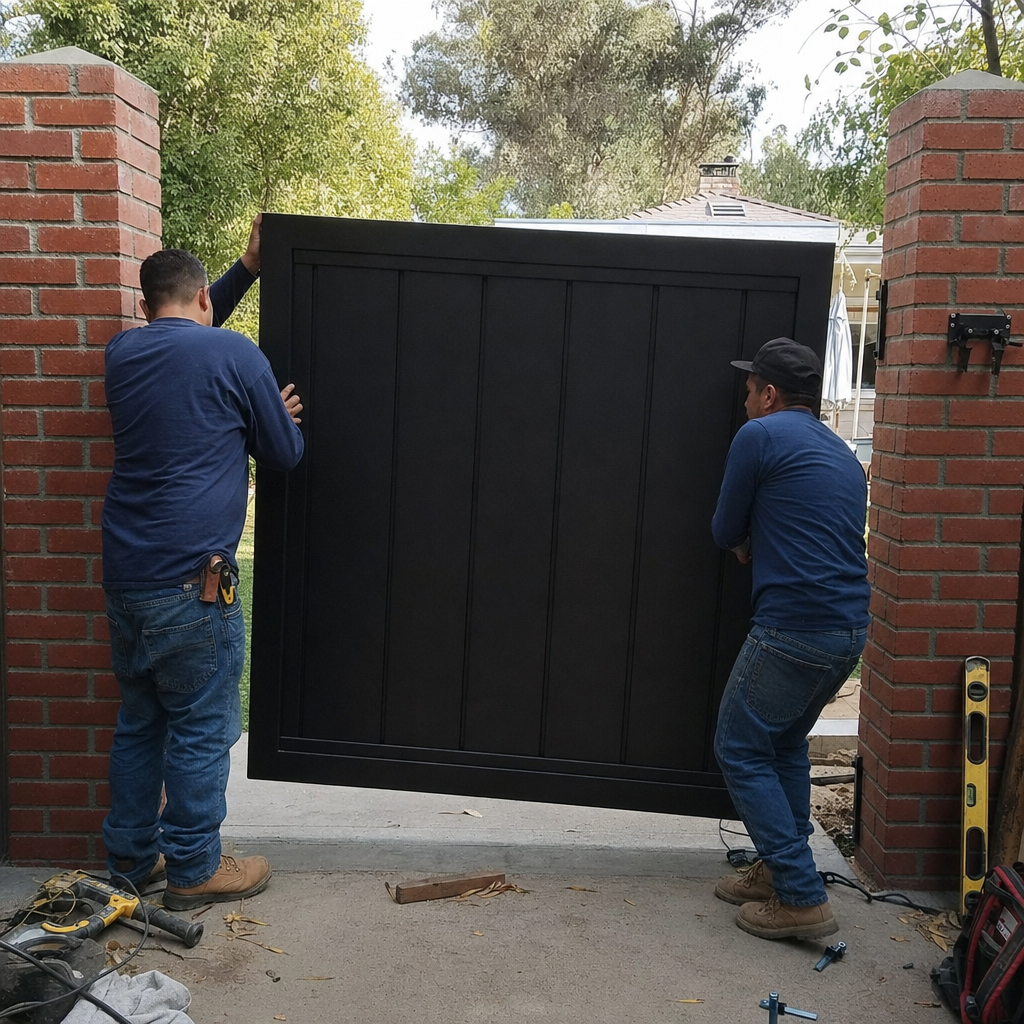
The pedestrian gate is what you touch every day, set in the low iron fence along your front yard. In Washington, these are often original to the house, with cast-iron frames that have rusted through where they meet the masonry stoop. We recently installed a new swing gate for a Logan Circle rowhouse where the original had failed at the base and the post was set directly into brownstone without a sleeve, requiring careful chiseling and a custom-fabricated post mount. Standard pedestrian gates run $2,800-$4,200; custom forged work in a Historic District runs $4,500-$7,500.
Security Gate Installation
For homeowners who want controlled access without sacrificing historic character, we install security gates that read as original from the street. In Washington, that means wrought-iron design with integrated electronic access: keypad, intercom, or remote. We specify corrosion-resistant coatings rated for DC’s humid summers and anchor posts to withstand wind loads off the Potomac. Security gate installation with access control runs $7,000-$12,500.
Do I need HPRB approval to replace my historic gate in Washington?
Yes, if your property sits in a designated Historic District. The Historic Preservation Review Board must approve any exterior alteration, including gate replacement. We handle the documentation, including measured drawings and material specifications, and design replacements the HPRB will approve because they read as historically appropriate. Call (833) 754-7503 and we’ll check your property’s status.
Gate Motor & Opener in Washington
Gate motor and opener repair in Washington typically costs $280-$650 for most residential jobs, and our technicians are on the road in the District every day. The tight alleyways of Capitol Hill, the narrow stoops of Georgetown, and the compact entries of Logan Circle rowhouses demand openers that fit where clearance is measured in inches. For details on what we service and install, see our Gate Motor & Opener page.
Linear Motor Installation
Linear motors are our most recommended solution for Washington’s narrow alley gates and tight stoop clearances. These compact units mount parallel to the gate leaf, needing as little as 4 inches of side clearance versus 18-24 inches for a traditional swing-arm operator. In Georgetown and Logan Circle, where a gate might open within arm’s reach of a parked car, linear motors eliminate the collision risk. Linear motor installation runs $580-$920, and we stock Linear and FAAC units on our Washington service trucks.
Motor Repair
Most motor repairs in Washington cost $280-$520. Washington’s climate is the root cause of many failures: moisture gets into rust pockets on aging iron gates, expands when it freezes, and cracks welds on gate brackets. By spring, the slide track is misaligned and the motor is binding. We see this pattern every year in neighborhoods near Rock Creek and the Anacostia floodplain, where ground moisture stays persistently high and corrodes underground conduit.
Can I motorize my 100-year-old iron gate in Washington?
Usually yes, after we restore the gate’s structural integrity. Sagging indicates rotted posts, cracked welds, or both. In Washington’s Historic Districts, we repair and re-forge the original iron rather than replace it, satisfying HPRB requirements and preserving original craftsmanship. Once the gate swings freely, we size a motor to its actual weight and geometry. Call (833) 754-7503 for an assessment.
Gate Access Control in Washington
Gate access control repair and installation in Washington typically runs $340-$780 for most residential jobs, with same-day service available when you call before noon. If your keypad, remote, or intercom system is failing on an iron gate in Capitol Hill, Georgetown, or Logan Circle, we can usually diagnose and fix it in a single visit. For the full range of what we install, see our Gate Access Control page.
Keypad Entry Systems
Keypad entry is the workhorse of Washington rowhouse gates, especially on narrow Capitol Hill and Shaw walkways where visitors arrive on foot. We install weather-rated keypads that withstand DC’s 40 inches of annual rainfall and summer humidity that fries lesser electronics. For historic gates, we fabricate custom mounting brackets that don’t require drilling through original iron finials or cast-iron scrollwork. A typical keypad installation on a Washington iron gate runs $380-$620.
Video Intercom Systems
Video intercoms on Washington’s historic gates demand a different approach than on modern aluminum installations. The masonry walls and thick iron frames of Georgetown and Logan Circle rowhouses block wireless signals that work fine in suburban vinyl siding. We run shielded low-voltage cable through existing gate posts where possible, or through discreet surface conduit painted to match the iron. Video intercom installation runs $560-$1,340 depending on the system.
Can I add smart access to my 1920s gate without replacing it?
Almost always, yes. We retrofit smart controllers that work with your existing gate hardware and actuator, adding Wi-Fi or cellular connectivity without touching the historic iron. In Washington’s Historic Districts, this is often the only legal path, since HPRB review can deny full gate replacement. Smart retrofits on historic iron gates run $670-$980. Call (833) 754-7503 to schedule a survey.
Gate Parts & Welding in Washington
Gate parts and welding repair in Washington typically runs $180-$650 depending on the component, with most hinge and rail jobs completed in a single visit. We fabricate and fit gate hardware for the specific demands of Washington’s rowhouse stock: original iron that hasn’t been touched since the McKinley administration. For details on our fabrication capabilities, see our Gate Parts & Welding page.
Hinge Replacement
Washington’s original Victorian and Edwardian iron gates were hung on hinges forged for a different era. After 80-130 years, those hinges have often rusted through at the pin or seized from neglect. In DC’s Historic Districts, simply swapping in a modern hinge can violate HPRB guidelines. We fabricate custom replacement hinges that match the original footprint and load capacity, welding them to the gate frame and post with attention to the original angle and swing arc. Hinge replacement runs $220-$380 per hinge, welded.
Post Replacement
Gate post replacement in Washington presents challenges you won’t find in suburban markets. Many Capitol Hill and Georgetown properties have posts set directly into original brownstone or brick stoops without any steel sleeve. When the post rusts through at grade, the fix requires chiseling out historic masonry, which itself may need HPRB sign-off. Post replacement with masonry work on a historic stoop runs $450-$650.
Can you match the exact scrollwork on my Capitol Hill Victorian gate?
Yes. Our custom welding service replicates Victorian scrollwork, finials, and rail profiles from photographs or existing pieces. We recently re-forged a rusted hinge on an original 1890s iron gate in Logan Circle, matching the scrollwork with a custom-welded piece that satisfied HPRB requirements. Matching work starts at $300 and requires on-site measurement. Call (833) 754-7503 for an estimate.
Brands We Service in Washington
We’re trained and equipped on nine gate-automation brands, including FAAC, BFT, Linear, and Viking. We stock common parts locally for faster turnaround on Washington service calls. See our brands for the full list.
Pricing for Gate Repair in Washington, DC
| Service | Typical range in Washington |
|---|---|
| Hinge repair or replacement | $180 - $290 |
| Weld repair (on-site mobile welding) | $220 - $380 |
| Post repair with rust treatment | $340 - $550 |
| Post replacement with masonry work | $480 - $650 |
| Gate realignment | $195 - $320 |
| Rust treatment and refinishing | $260 - $420 |
| Automatic opener diagnostic & repair | $195 - $395 |
What pushes Washington jobs toward the higher end: HPRB documentation requirements, masonry restoration on brownstone stoops, custom forging to match original profiles, and restricted access that extends labor time. We settle a firm, upfront price before any work begins, and every repair over $250 qualifies for $50 off automatically.
Neighborhoods We Serve in Washington
We work across the District, from the historic rowhouse blocks to the estate driveways. Most calls within Washington proper reach us in under an hour during business hours.
- Capitol Hill
- Georgetown
- Logan Circle
- Shaw
- Navy Yard
Service Area - Cities Near Washington
Our Washington, DC office coordinates dispatch and scheduling for work throughout the District and surrounding communities. If you’re in Washington, DC or nearby Washington, D.C., DC, we can send a technician to assess your gate and provide a free estimate. Call (833) 754-7503 and a live person will answer, any hour, any day.
Serving Washington, DC - Our Local Coverage Area
Ironworks Gate Co. crews serve Washington and the communities around it; dispatch is coordinated from our Washington, DC office. The map shows the Washington coverage area; if your address is on it, we can help.
Also serving nearby: Washington, DC, Washington, D.C., DC.
FAQs About Gate Repair in Washington
Most calls within Washington proper reach us in under an hour during business hours, and we offer same-day service for repair calls placed before noon. A live person answers the phone 24 hours a day, 7 days a week. Call (833) 754-7503 to schedule, and we’ll be there when we say.
Yes. When a repair or installation requires Historic Preservation Review Board approval, we document the work with measured drawings, material specifications, and photographs, and we design solutions the HPRB will approve because they read as historically appropriate. We handle the paperwork as part of the job.
If your gate is sagging, rusted, or stubborn, call (833) 754-7503 for a free estimate. Victor Salinas and the Ironworks Gate Co. team will give you an upfront price before any work begins, and every job is backed by our written 90-Day Done Right Promise. Done right, and backed in writing.
What happens when you call
- 1A real person answersNo phone trees - talk to a local gate repair pro.
- 2You get an upfront price rangeHonest numbers before anyone is dispatched. No surprises.
- 3We come out and measureLicensed & insured, at a time that suits you - the visit and the quote are both free.
- 4You get the price in writingLine-itemed, yours to keep, and nothing starts until you say go.
What Washington Customers Say
"The hinge post had rotted at the base and the whole swing gate was sagging into the concrete. He rebuilt the post rather than talking us into a new gate, which two other companies had pushed for."
- Megan Whitaker"Reprogrammed every clicker in the community and set up the keypad codes. Patient with a very long list of residents."
- Devon Ingram"Gate stopped halfway and sat there for two days blocking the driveway. He found a dead capacitor in the operator, had one on the truck, and we were moving cars again inside an hour."
- Chris Gallagher