
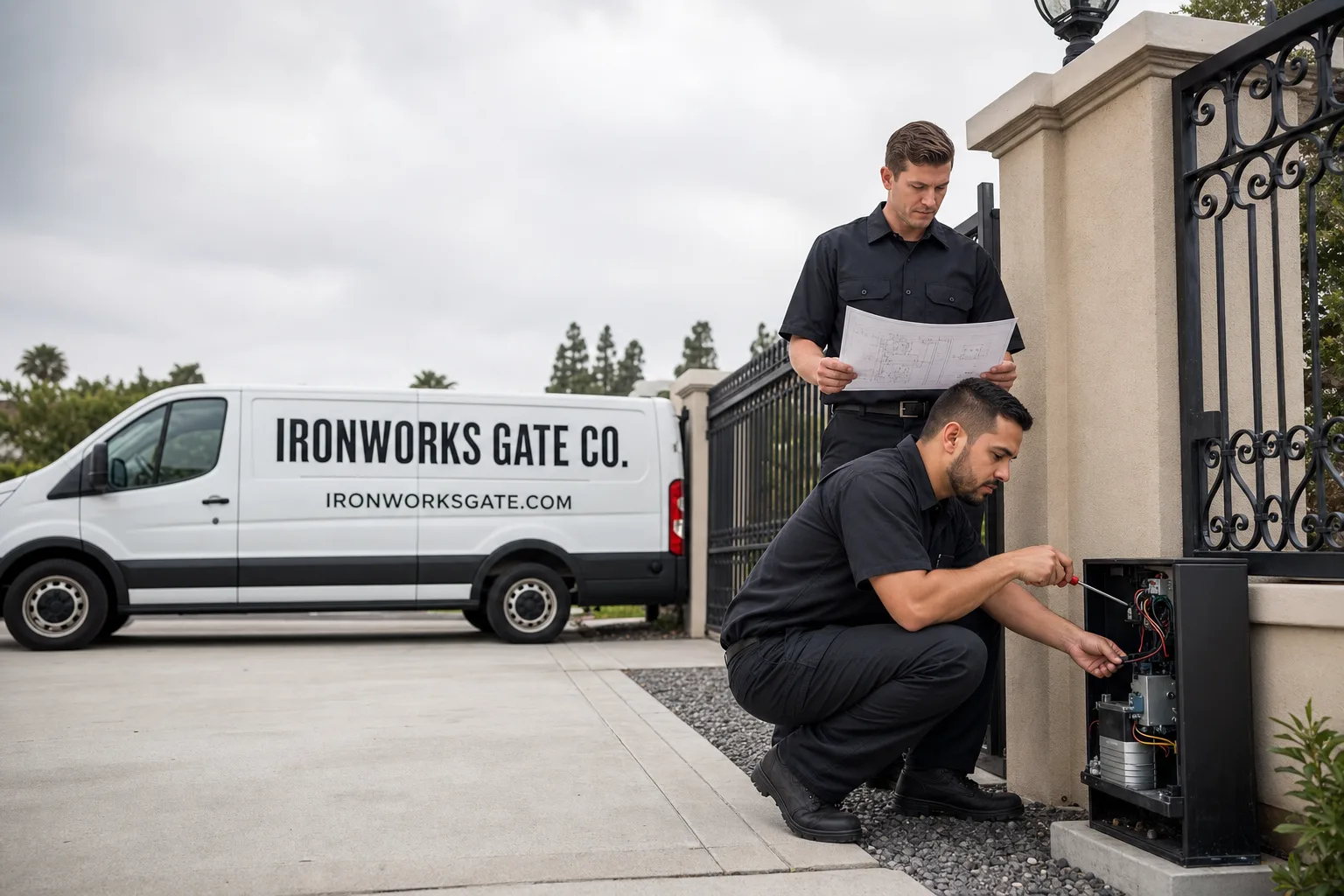
Gate Hinges Sagging or Dragging on the Ground
A gate that sags or drags on the ground almost always means one or more hinges have failed, the post they’re anchored to has shifted, or the gate frame itself has racked out of square. It is a structural problem, not a surface one, and it won’t correct itself. Left alone, a dragging gate grinds its own frame, damages the driveway surface, and – if it’s automated – can burn out a motor that was otherwise perfectly fine.
The good news is that a dragging gate is one of the most fixable problems we see. Most of the time your local Ironworks Gate Co. team can diagnose the root cause on the first visit and complete the repair the same day. The key is figuring out which of the three or four possible causes is actually at work, because the fix is different for each one.
Why It Happens
1. Hinge Wear or Hinge Failure
Hinges are the most common culprit, full stop. A residential gate hinge carries the weight of the gate every single time it cycles, and over years that load wears the pin-and-barrel joint oval instead of round. When that happens, the gate drops. You can usually confirm this yourself: stand back and look at the hinge gaps along the gate’s hanging edge – if the top hinge gap is wider than the bottom, the hinge is worn and the gate is dropping from that joint. On heavy iron or steel gates, the hinge barrel can crack entirely, and you may see a visible split or hear a metallic groan when the gate swings.
2. Post Heave or Footing Failure
The post the hinges are welded to must stay perfectly plumb – even a few degrees of lean puts the gate’s leading edge on the ground. Soil movement, frost heave in colder climates, erosion, or a footing that was poured too shallow all cause the post to shift over time. The test here is simple: look at the post from the side. If it’s leaning toward the gate’s path of travel, the post has moved – and no amount of hinge work will hold the gate level until the post is reset.
3. Frame Racking or Weld Failure
Gate frames – especially welded steel or iron ones – can rack out of square when a corner weld cracks. This often happens after an impact (a vehicle, a strong wind gust, or a decade of a gate slamming open against its stop). When the frame racks, the geometry of the whole gate shifts and the bottom corner drops to the ground. You’ll notice the gate looks like a parallelogram instead of a rectangle, or that one corner of the frame is visibly lower than the other side.
4. Hardware Loosening at the Anchor Point
On brick or masonry pillars, hinges are typically lag-bolted or chemically anchored into the substrate. Those anchors can loosen over time, especially if the gate cycles frequently or the pillar has developed small cracks. The gate will sag gradually and the hinge may feel springy or flex under load rather than holding firm. If you push lightly on the gate near the hinge and can feel the hinge plate move against the pillar surface, the anchor point has given way.
What to Do Right Now
- Stop cycling the gate. Every open-and-close with a dragging gate grinds the frame, scores your driveway, and puts stress on any automated motor or opener attached to it. If the gate is automated, disconnect it from the opener arm so the motor doesn’t keep trying to force it. Most openers have a quick-release cord for exactly this situation – pull it and leave the gate in manual mode until the repair is done.
- Photograph the hinge gaps before you touch anything. Take a clear photo of the gap along the hinge side from top to bottom, one of the post from a distance (to show any lean), and one of the corner where the gate is dragging. These photos help the technician understand what the gate looked like before arrival and can reveal whether the problem is getting worse between visits.
- Check the post with a level if you have one. Hold a level against the face of the hinge post. If the bubble is off center, note which direction it’s leaning. This takes thirty seconds and gives your technician useful information before they even see the gate.
- Do not attempt to re-weld, re-hang, or jack the gate yourself. A sagging gate under tension from an automated opener can drop suddenly and the weight of an iron or steel gate causes serious injury. Hinge replacement on a heavy gate requires it to be properly supported while the old hardware comes off – this is not a ladder-and-drill job.
- Call (833) 754-7503 to schedule the repair. A live person answers around the clock, every day of the week – no voicemail, no waiting until Monday. The sooner the gate is looked at, the less secondary damage accumulates.
How We Fix It
When your local Ironworks Gate Co. technician arrives, the first thing they do is a full structural assessment: hinge condition, post plumb, frame geometry, and anchor integrity. They’ll identify the root cause – not just treat the visible symptom – before any work begins. You’ll receive a written, upfront price for exactly what needs to be done before a single bolt is turned. No surprises on the bill.
The repair itself falls under our Gate Repair and, where frame or hinge metal needs to be rebuilt, our Gate Parts and Welding service. Worn hinges are replaced with correctly rated hardware for your gate’s weight. Cracked welds are ground clean and re-welded to spec. If the post has heaved, the technician will advise on footing correction – which may be the same visit or a follow-up depending on the scope. Most hinge and frame repairs are complete in two to four hours.
Every completed repair is backed by the 90-Day Done Right Promise – the Keystone Standard. Written, no paperwork, no arguing. If it isn’t right, we come back and make it right.
Frequently Asked Questions
A dragging gate is a safety concern that should not sit unaddressed. A gate that’s already stressing a cracked weld or a loose anchor point can fail completely – meaning the gate drops or swings free – and a full-weight iron or steel gate falling unexpectedly causes serious injury. Beyond the safety issue, every day it runs in this condition is extra wear on the frame, the driveway surface, and the motor if it’s automated. If the problem started recently and the drag is minor, it’s urgent but not a middle-of-the-night emergency for most homeowners. If the gate is visibly pulling away from the post or the hinge is cracked through, stop using it and call now: (833) 754-7503.
Your local Ironworks Gate Co. team handles gate repairs every day of the week, and a live person is available at (833) 754-7503 right now to get you scheduled. We’ll tell you honestly what the availability looks like in your area and get the earliest appointment on the books. Call (833) 754-7503 – no voicemail, no callback queue.
In most cases, the gate itself is fine – it’s the hinges, the post, or a weld at a corner joint that has given way, and those are all repairable. A full gate replacement is usually only necessary when the frame has been bent by a significant impact or has corroded past the point where welding holds reliably. Your technician will give you a straight answer on that assessment, in writing, before any work begins – and you’re never obligated to proceed.
Yes, it can. When a gate drags, the opener motor works against the friction every cycle – it’s like driving with the parking brake on. Over enough cycles, the extra load overheats the motor or strips the drive mechanism. The best thing you can do right now is disconnect the opener from the gate arm (most have a simple quick-release) and leave the gate stationary until the structural problem is corrected. Once the gate swings freely and level again, the opener can be reconnected – and a technician will verify it wasn’t damaged in the process.
Get It Fixed
Call (833) 754-7503 – a live person answers right now, any time of day or night. Your local Ironworks Gate Co. team will assess the hinge, the post, and the frame, give you a written price before anything starts, and back the repair with our 90-Day Done Right Promise.
Written by Victor Salinas, Owner at Ironworks Gate Co., proudly serving local communities since 1984.