
What’s Happening
When your gate buzzes but won’t move, the motor is receiving power but something is stopping it from turning the gate. In almost every case, the cause is a mechanical obstruction, a failed or undersized capacitor, a seized motor, or a gate that has shifted off its track or hinges to the point where the opener can no longer overcome the resistance.
The buzz itself is actually useful information. Silence would mean no power at all. A buzz tells you the control board is alive and the motor is trying. The problem is downstream – either the path is physically blocked, or the motor’s starting components have worn out and it can spin up no more. A trained technician can usually pinpoint which one it is within the first few minutes on site, because each cause has its own signature: what the gate feels like when pushed by hand, whether the buzz holds steady or pulses, and whether the motor housing is hot to the touch.
Why It Happens
A Failed or Weak Capacitor
The capacitor is a small cylindrical component that gives the motor the burst of energy it needs to start moving. When it weakens or fails, the motor hums at full effort but never gets the jolt it needs to spin. This is one of the most common causes of the “buzzing but not moving” symptom, and the tell is straightforward: the gate sits exactly where it stopped, the motor runs warm quickly, and nothing moves even when there is no visible obstruction. On older openers – anything running a LiftMaster, FAAC, or BFT unit that has been on the post for more than eight or ten years – the capacitor is often the first component to go.
A Gate That Has Shifted or Is Binding
Gates are heavy. Hinges wear, posts settle, and concrete heaves with the seasons. When a gate shifts even a fraction of an inch, the opener that was sized for a freely-swinging gate suddenly has to fight friction it was never meant to handle. Try opening the gate by hand with the motor disengaged: if it moves stiffly, drags on the ground, or requires real effort, the opener is not the problem – the gate’s alignment is. You’ll often hear a grinding sound under the buzz, or see a scuff mark where the gate is dragging along the ground or the stop plate.
A Seized or Overheated Motor
Motors have thermal overload protection built in. If the gate has been cycling repeatedly – a stuck gate that someone kept triggering hoping it would eventually move – the motor may have tripped its thermal cutout and locked itself. The buzz comes because current is still reaching it, but the thermal protection has cut the rotor circuit. The motor housing will feel noticeably hot, and the buzz may be louder than usual. Letting it cool for thirty minutes sometimes restores movement temporarily, but if it seizes again quickly, the motor or its internal components need inspection. This is a job for a technician, not a reset button.
A Drive Arm, Chain, or Gear at Its End of Life
Swing-gate operators use arms and pivot joints; slide gates use a rack-and-pinion or chain drive. Any of these can strip a gear tooth, crack a drive arm, or throw a chain. When that happens, the motor spins freely but nothing translates that motion to the gate – which is why the gate doesn’t move even though you can hear the motor working. Look at the connection between the motor unit and the gate itself. If the arm is visibly cracked, bent, or disconnected at one end, or if you can see a chain hanging slack, you’ve found your answer.
What to Do Right Now
- Stop triggering the opener. Every failed attempt runs current through a motor that is already struggling. If there is a heat or seize issue, repeated cycling makes it worse and can shorten the motor’s remaining life significantly.
- Disengage the opener and test the gate by hand. Most operators have a manual release – a pull cord or a knob near the motor unit. Once disengaged, try to move the gate yourself. If it swings or slides freely, the gate itself is not the problem. If it is stiff, drags, or won’t move at all, the gate has a mechanical issue that needs to be addressed before the opener can do its job.
- Look, but don’t touch the motor housing or wiring. Check for obvious signs: a cracked drive arm, a disconnected chain, a gate visibly resting on the ground or leaning. Take a photo on your phone. That photo is genuinely useful to the technician before they even arrive. Do not open the motor housing, probe terminals, or attempt to bypass any wiring – gate operators run on line voltage, and the capacitor stores a charge even after power is cut.
- Note when and how the buzzing started. Did it fail mid-cycle, or did you hit the button one morning and nothing happened? Did it work sluggishly for a few days before stopping? That timeline narrows the diagnosis before anyone picks up a wrench.
- Leave the gate in whatever position it stopped. If it stopped halfway open, leave it halfway open. Forcing it manually when hinges or a drive arm are already stressed risks bending something that was still repairable.
How We Fix It
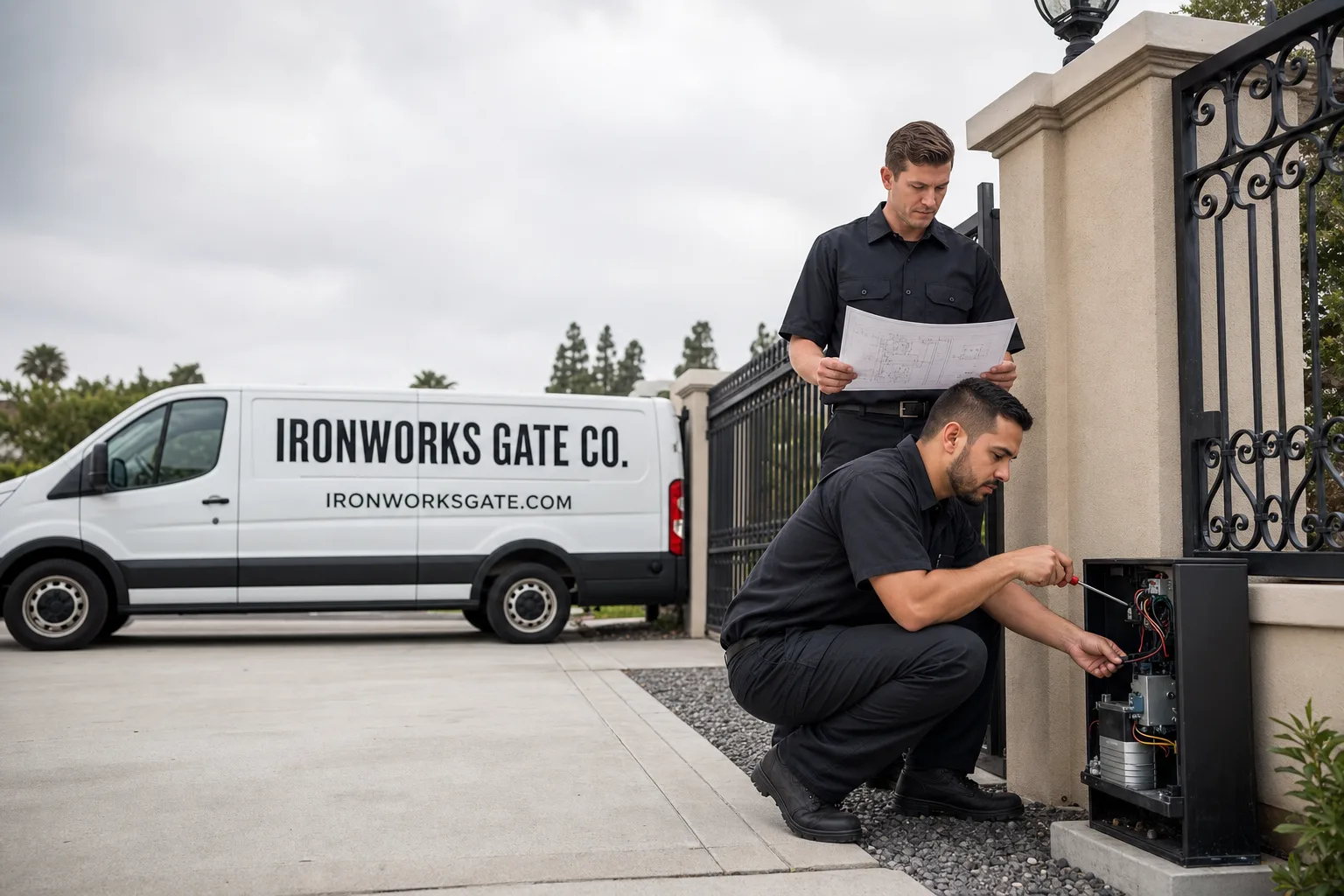
When your local Ironworks Gate Co. team arrives, the first thing a technician does is run a manual test – gate disengaged, moved by hand – to separate a mechanical problem from an electrical one. That single step tells us a great deal before we open any panel.
From there, we check the capacitor and motor under load, inspect the drive arm or chain for wear and damage, and look at the gate’s alignment along its full travel path. On operators we service – LiftMaster, FAAC, BFT, Linear, Viking, Ghost Controls, DoorKing, Elite, and Mighty Mule – we carry the replacement components most commonly needed on the truck, so the correct fix is usually made in a single visit.
Before anything is replaced or adjusted, you’ll have upfront pricing in writing – the exact cost for this job, settled before a single bolt turns. Most repairs of this type are completed the same day. Every repair is covered by our 90-Day Done Right Promise: if it is not right, we come back and make it right. No paperwork, no arguing, no exceptions. That is the Keystone Standard, and it applies to every job we do.
The service that resolves this symptom is Gate Repair. If the diagnosis points to a motor at the end of its service life, Gate Motor and Opener replacement may be the better path – and we will tell you honestly which one makes more sense for your gate and your situation.
Frequently Asked Questions
It depends on where the gate stopped. A gate sitting halfway across a driveway is a safety hazard – for vehicles, for children, and for anyone who tries to force it manually without knowing what has failed. A gate that stopped in the closed position is less urgent but still should not be left cycling repeatedly. Stop triggering the opener, secure the gate manually if you can do so safely, and call (833) 754-7503 – a live person answers around the clock, every day of the week.
A buzzing motor that is not moving is working against itself every time it is triggered. Continued cycling can damage a capacitor that might otherwise have been a simple fix, or overheat a motor that could have been salvaged. It is not always an emergency, but it is not something to keep running either. The sooner it is diagnosed, the better the odds of a clean, affordable repair. Call us at (833) 754-7503 and we will help you decide how quickly it needs to be addressed.
Your local Ironworks Gate Co. team works to get to you as quickly as possible, and our phones are answered by a live person 24 hours a day, 7 days a week – not a voicemail, not a callback queue. Call (833) 754-7503 right now and we will tell you exactly when a technician can be there. Most jobs are completed in a single visit, so you are not looking at a two-trip ordeal.
Honest answer: it depends on the motor’s age, brand, and what the diagnosis shows. A failed capacitor is a repair, not a replacement, and it is often one of the more straightforward fixes in gate automation. A motor with a burnt winding or a cracked housing is a different story. We will give you the straight answer after we look at it – in writing, with pricing, before anything starts. We have been doing this for over 42 years, and a square deal on the estimate is non-negotiable for us.
Get It Fixed
Call (833) 754-7503 right now – a live person answers every call, day or night. Your local Ironworks Gate Co. team will diagnose the problem, give you upfront written pricing before touching anything, and get your gate moving again. Most repairs are done the same day, and every job is backed by the 90-Day Done Right Promise.
Written by Victor Salinas, Owner at Ironworks Gate Co., serving local communities across the country since 1984.