
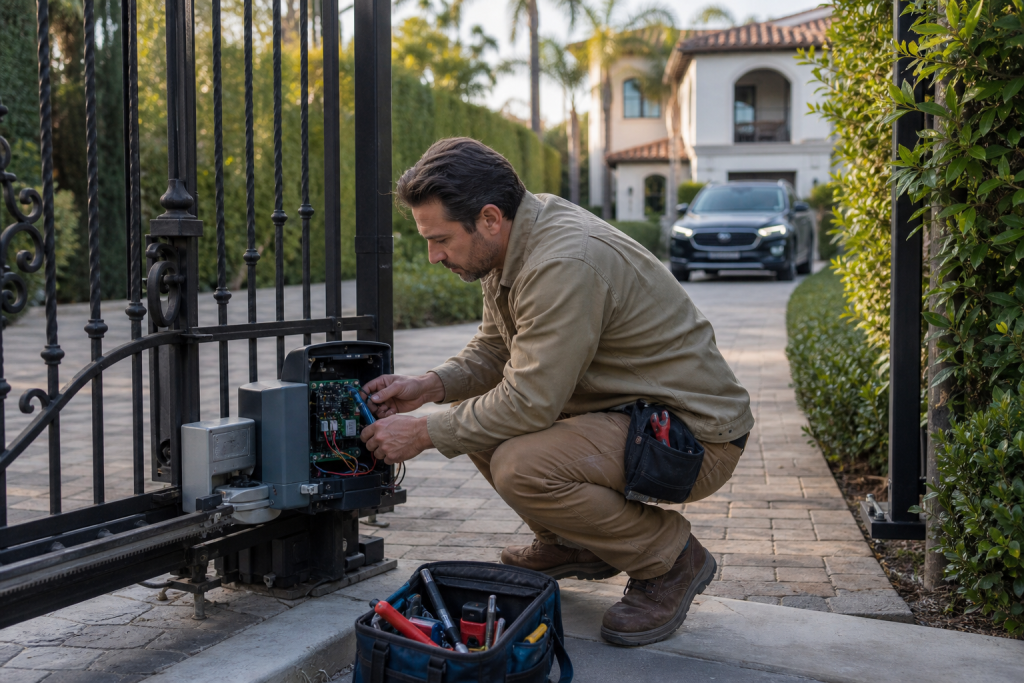
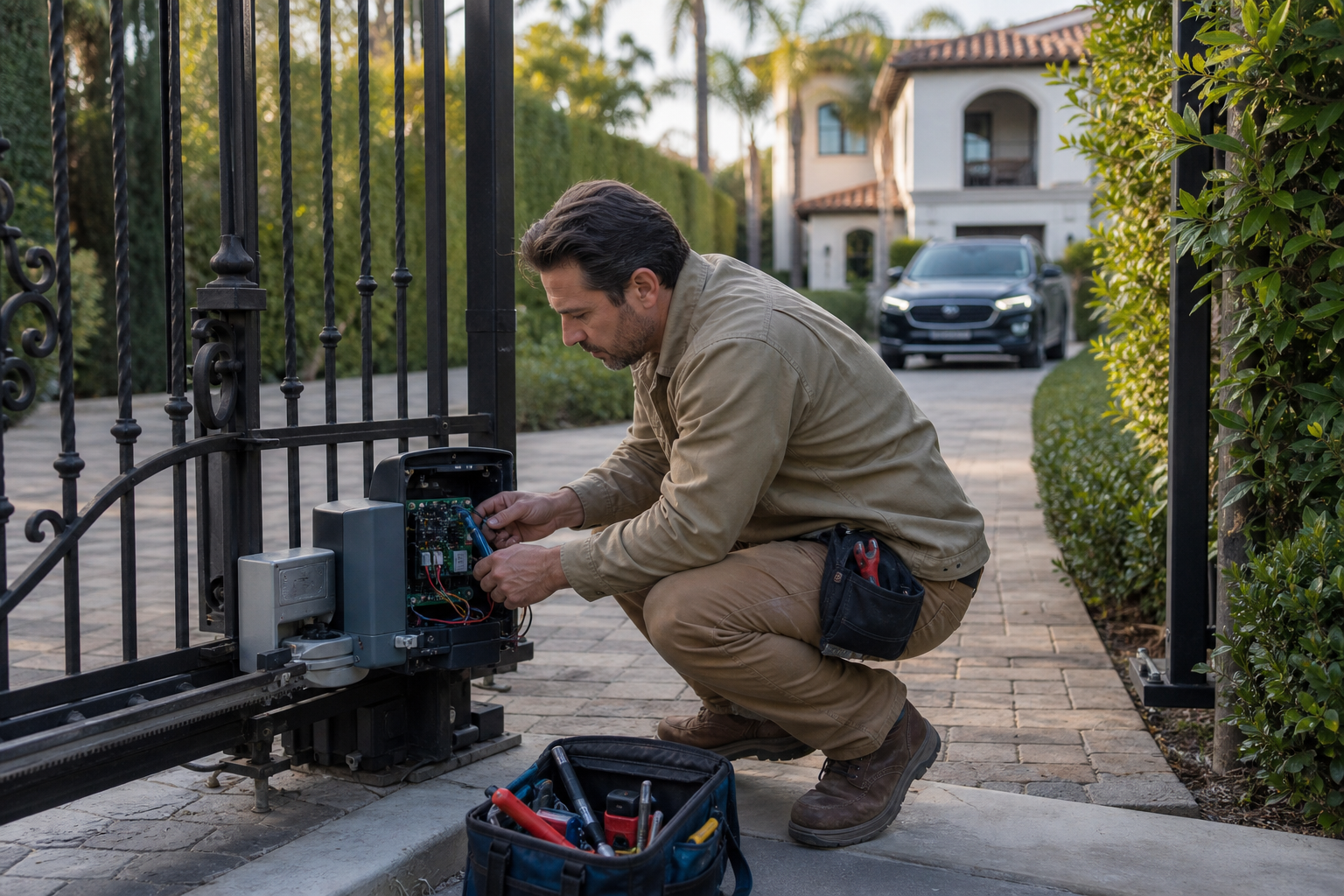
Gate Access Control: Repair or Replace? How Los Angeles Homeowners Decide
Most gate access control problems in Los Angeles can be repaired for $180-$650, while full replacement runs $1,800-$4,500 installed. The key is knowing whether your failure is in the reader head, credential database, control board, or communication interface - because more than half of “dead” systems we diagnose are actually a single replaceable component or a firmware issue. If you’d rather not sort this out yourself, call us at (833) 754-7503 for a free, no-pressure estimate.
When a gate access panel stops accepting codes or reading fobs, most homeowners hear “you need a new system” within ten minutes of a technician’s arrival. In our experience across Los Angeles - from Hancock Park to the Valley, from 1980s estate gates in Bel Air to newer HOA installations in Playa Vista - more than half of those calls are a firmware issue, a corrupted credential database, or a failed reader head. None of those require replacing the panel. The problem is that access control failures feel catastrophic. No entry. No remote response. The instinct is to tear it out and start over. But that instinct costs homeowners thousands of dollars they did not need to spend, and sometimes loses them years of credential data they cannot get back.
How Access Control Actually Fails: The Hierarchy Homeowners Should Know
Access control systems fail in a predictable order, and diagnosis should follow that same sequence. A technician who jumps straight to “the board is shot” is skipping steps that could save you serious money.
Level 1: The reader head. This is the physical component that reads key fobs, cards, or biometric data. Reader heads live outside, exposed to Los Angeles sun, Santa Ana dust, and occasional sprinkler spray. They fail physically - cracked lenses, corroded contacts, UV-degraded plastic. A reader head swap on a Linear or Viking system typically runs $180-$340 parts and labor. The panel itself is fine.
Level 2: The credential database. This is where authorized fobs and codes live. Database corruption happens after power surges, failed firmware updates, or simple memory decay in older systems. The hardware is intact; the data is scrambled. Recovery is sometimes possible, sometimes not. We have restored BFT databases that a previous technician declared “dead” - and we have had to tell homeowners that their ten-year fob list is genuinely gone. The difference is whether someone takes the time to attempt recovery before declaring replacement.
Level 3: The control board. This is the brain that processes inputs and sends open/close commands to the gate operator. Board failures do happen - capacitor bulge, moisture intrusion, surge damage. Replacement boards for common brands like Ghost Controls or DoorKing run $280-$550 installed, assuming the board is still manufactured. This is still far below full system replacement.
Level 4: The communication interface. For IP-connected panels, this means the network module. For telephone-entry systems, the POTS line interface. Los Angeles has a peculiar mix here - legacy analog systems in older neighborhoods, IP-based panels in newer construction, and plenty of hybrid installations that fail at the junction between the two. A “dead” system is often just an IP address conflict or a failed DSL-to-ethernet bridge.
Replacement should only enter the conversation after all four levels have been ruled out or priced against the cost of new hardware.
Why Los Angeles’s Mixed Infrastructure Creates Misdiagnosis
Los Angeles gate access control exists in layers of technology that do not always talk to each other cleanly. We see this constantly.
In neighborhoods like Los Feliz, Hancock Park, and parts of Pasadena, we still service telephone-entry systems installed in the 1990s that rely on analog POTS lines. AT&T has been retiring copper infrastructure for years, and many of these systems now connect through VoIP adapters that introduce latency, dropped digits, and phantom busy signals. The gate panel looks dead. The actual problem is a $45 adapter failing to translate protocols. We have had technicians from other companies recommend $3,200 replacements for this.
On the other end, newer developments in Playa Vista, Century City, and downtown high-rises run IP-based panels - often BFT or Linear - that integrate with building management systems. These fail differently. A firmware mismatch between the access panel and the network switch can lock out every resident. The panel hardware is fine; the handshake protocol is wrong. Updating firmware or reconfiguring VLAN settings resolves it. But a technician without network diagnostic tools sees a “dead” panel and sells a replacement.
The integration point is where most misdiagnosis happens. A gate technician who understands motors but not networks will replace hardware that was never broken. A network technician who understands packets but not gate systems will blame the panel for a network problem. We carry both skill sets because Los Angeles demands it.
The Credential Database Problem Nobody Talks About
This is the question every homeowner and HOA board should ask before signing off on replacement: What happens to our existing fobs and codes?
The answer is often: they disappear. And that loss has real consequences.
Many older access control systems - particularly certain Viking and early DoorKing models common across Los Angeles - store credentials in proprietary formats that newer panels cannot import. We have sat with HOA boards in the Valley who learned, too late, that their 200-unit fob registry would need manual re-entry at $15-$25 per credential. That is a hidden $3,000-$5,000 cost on top of the hardware replacement, plus weeks of resident inconvenience.
Even when migration is technically possible, it requires the old system to be functional enough to export data. A technician who powers down a “dead” panel and hauls it away may be hauling away your only copy of the credential database.
Before any replacement, ask these questions:
- Can our existing fobs and codes be migrated to the new system?
- Is the migration automated, or does it require manual re-entry?
- What is the cost per credential if manual?
- Can you extract the database from our current panel before removing it?
- Will residents need new fobs, and who pays for them?
A technician who cannot answer these clearly is not ready to replace your system.
Real Lifespan Benchmarks: When Replacement Is Actually Warranted
Access control hardware does have a real lifespan. The trick is distinguishing end-of-life from misdiagnosed failure.
Honest replacement indicators:
- The manufacturer has discontinued the product line and no longer stocks replacement boards or readers. We see this with certain Ghost Controls residential panels from the early 2010s and some Mighty Mule systems that were never designed for commercial cycle counts.
- Physical housing damage - cracked enclosures, corroded terminal blocks, UV-brittled plastic that will not seal - that compromises weather protection. Los Angeles sun is hard on plastic; we replace more housings than boards.
- Cycle count exhaustion. A residential-grade panel rated for 100,000 cycles that has handled 300,000 in a busy HOA installation has earned its retirement.
- Repeated, unexplained failures after component-level repair. One board failure is repairable. Three in eighteen months suggests systemic voltage or grounding problems that will keep killing replacement boards.
Misdiagnosed “end-of-life” we see regularly:
- “No parts available” - sometimes true, sometimes the technician does not have supplier relationships with older inventory. We source discontinued Linear and Viking components through specialized channels.
- “Obsolete technology” - often means “I am not trained on this system.” A 1990s telephone entry system is primitive, but if the line still works and the homeowner prefers it, “obsolete” is a sales pitch, not a technical assessment.
- “Not worth repairing” - a value judgment that should be the homeowner’s, presented with actual numbers. We will tell you the repair cost, the replacement cost, and what we would do if it were our gate. Then you decide.
Last month we pulled a panel out of a garage over in Los Feliz where a previous company had declared it “fried beyond repair.” Corroded power terminal. Thirty minutes with a terminal block kit and contact cleaner. The homeowner had been quoted $2,800 for a full replacement. We charged $195. He was not amused at the other company. We were not surprised.
Cybersecurity: The New Factor in the Replace Decision
For IP-connected access panels, replacement is no longer just a hardware question. It is a network security question.
Older panels - even some still manufactured - run firmware with known vulnerabilities that cannot be patched. We have diagnosed BFT and certain Linear systems in Los Angeles where the manufacturer released a security bulletin, but no firmware update followed because the hardware platform could not support modern encryption standards. The panel opens the gate fine. It also sits on your network with an unpatched vulnerability that a basic port scan will find.
This matters for residential estates with integrated home networks. It matters enormously for multi-family properties where the access panel shares infrastructure with tenant WiFi, security cameras, and building management systems. A compromised access panel can be a pivot point for broader network intrusion.
Physical repair cannot fix a firmware vulnerability. If your panel is IP-connected and the manufacturer has discontinued security support, replacement becomes a genuine recommendation - not because the gate won’t open, but because the network exposure is unacceptable.
Ask your technician: Is this panel still receiving security firmware updates? When was the last one? Is there a published vulnerability for this model? These are reasonable questions in 2025, and any technician working on networked access control should be able to answer them.
When to Call a Pro
If your access panel has stopped responding, start with the basics: check power at the panel, test a second fob or code, and verify whether the gate operator itself still responds to manual controls. If those checks do not reveal an obvious fix, the next step is diagnostic, not replacement. A qualified technician should be able to identify which of the four failure levels applies, quote repair versus replacement with real numbers, and explain your credential migration options before any hardware comes off the wall.
Related services in Los Angeles: Gate Repair in Los Angeles, Gate Installation in Los Angeles, and Gate Motor & Opener in Los Angeles.
The Bottom Line
Access control replacement is sometimes necessary. More often, it is sold prematurely to homeowners who do not know the diagnostic questions to ask. The hierarchy is reader, then database, then board, then interface - with replacement only after all four are exhausted or priced against new hardware. In Los Angeles’s mixed infrastructure environment, compatibility problems masquerade as hardware death. Credential databases get lost in rushed replacements. And IP-connected panels now carry cybersecurity considerations that pure physical repair cannot address.
We have been Ironworks Gate Co. since 1984 - over 42 years - and we have seen every access control system Los Angeles has to offer, from 1980s telephone entry to modern IP-integrated panels. Our technicians are trained and equipped on nine major brands, and every job carries our written 90-Day Done Right Promise: if it is not right, we come back and make it right, no paperwork, no arguing.
If you are weighing repair against replacement on your Los Angeles gate access system, call (833) 754-7503. We will diagnose it properly, explain your options in plain language, and give you upfront pricing before a single bolt is turned. Estimates are free. Second opinions on any written estimate are free. And if you are a senior or veteran, we apply a 5% discount to every job, always.
Frequently Asked Questions
Most repairs fall between $180 and $650, depending on which component has failed. A reader head replacement typically runs $180-$340. Control board replacement is $280-$550. Database recovery or firmware updates range from $150-$400 if the hardware is intact. Full system replacement starts around $1,800 and can exceed $4,500 for multi-family or IP-integrated installations. Call (833) 754-7503 for an exact quote on your system - estimates are free.
Repair is almost always cheaper if the failure is isolated to a reader head, database issue, or single board. Replacement becomes the better financial choice when the manufacturer has discontinued support, the housing is physically compromised, or repeated component failures suggest systemic problems like voltage irregularities. We evaluate both paths and give you actual numbers. Our $50 off any repair over $250 and free second opinion on any written estimate help you compare with confidence.
Most single-component repairs - reader heads, power supplies, basic board swaps - are completed in one visit because our trucks carry inventory for nine major brands: LiftMaster, FAAC, BFT, Linear, Viking, Ghost Controls, DoorKing, Elite, and Mighty Mule. Database recovery or firmware issues sometimes require remote factory support, which can add a day. Full replacement typically requires one visit to measure and specify, plus a second for installation. Call (833) 754-7503 - a live person answers 24 hours a day, 7 days a week.
Sometimes, but not automatically. Many older systems store credentials in proprietary formats that newer panels cannot import. Migration may be possible if the old system is functional enough to export data, or it may require manual re-entry at $15-$25 per credential. Before any replacement, ask your technician specifically about migration path and cost. We always attempt database extraction before removing legacy hardware, and we will tell you honestly when migration is not possible. For an assessment of your specific system, call (833) 754-7503.
Written by the team at Ironworks Gate Co., serving Los Angeles since 2013.
Need Gate Repair Help?
Call Ironworks Gate Co. - licensed & insured, here with fast after-hours help in Los Angeles.
(833) 754-7503