
Gate Closes on Its Own
A gate that closes by itself almost always has one of three causes: the auto-close timer in the operator has been triggered or accidentally changed, a limit switch or control board inside the motor unit has failed, or the gate’s safety sensors are sending a false signal that tells the opener to reverse and close. In most cases, a trained technician can identify the exact cause on the first visit and correct it the same day.
The frustrating part about this symptom is that it looks like a gate doing something intelligent when it is actually doing something wrong. The opener’s brain has received a command it was not supposed to receive, and it is acting on it faithfully. Until the source of that command is found and stopped, the gate will keep closing on its own no matter how many times you open it manually. The right move is to diagnose what is sending that signal, not to keep overriding it.
Why It Happens
The Auto-Close Timer Is Set or Has Drifted
Most modern gate operators include a built-in timer that can be programmed to close the gate automatically after a set number of seconds. This is useful – until it is not. If someone in your household recently changed a setting, or if a power fluctuation reset the operator’s memory, the timer can activate without anyone meaning to turn it on. The giveaway is that the gate closes at a consistent interval every single time you open it, almost like clockwork.
A Limit Switch Has Failed or Shifted
The limit switch tells the operator where “fully open” is. When that switch wears out or physically moves on its mounting bracket, the motor never registers that the gate reached its open position. Thinking the gate is still in motion, the controller reverses direction and pushes it closed again. You may notice the gate stopping short of fully open before it starts coming back, or a faint clicking sound from inside the motor housing just before it reverses.
A Safety Sensor or Photocell Is Triggering a False Signal
Gate operators on most residential and estate installations include safety sensors – typically a pair of photocells mounted near ground level – that detect obstructions. When one of those sensors is dirty, misaligned, or has a failing lens, it may read a clear driveway as a blocked one and send a close command as a “safety” response. Check whether a small indicator light on the sensor unit is flashing or has gone out entirely; that is usually the first visible sign that the sensor is the problem.
A Faulty Control Board or Damaged Wiring
The circuit board inside the operator interprets every signal that comes in – from remotes, keypads, sensors, and timers – and decides what the gate should do next. When a board begins to fail, or when a wire carrying a signal has been chewed by pests or corroded by moisture, the board can receive phantom commands and act on them. This cause is less obvious to spot from the outside, but if you hear the operator clicking or humming at random intervals, or if the behavior started right after a storm or a power surge, the control board or wiring is worth suspecting.
What to Do Right Now
- Stop forcing the gate open repeatedly. Every time you override an automated close cycle without knowing the cause, you are adding wear to the motor and the drive components. If the gate is closing on its own, treat it as a malfunction, not an inconvenience to outlast.
- Check the sensor indicator lights. Walk to the photocell units mounted on each side of the gate opening. Look for a small LED. If it is blinking or dark when the driveway is clear, the sensor is likely misaligned or dirty. Gently wipe the lens with a dry cloth – do not spray cleaners – and see if the light stabilizes. Photograph what you find before touching anything.
- Look at the gate’s position when it stops opening. If it consistently stops two or three feet short of fully open before reversing, that points toward a limit switch issue rather than a sensor. Note the exact stopping point so you can describe it when you call.
- Do not adjust or open the operator housing yourself. The capacitors inside a gate motor store an electrical charge even when the unit is unplugged. Internal electrical components carry real risk of shock injury. Observation and description are genuinely useful; taking the housing apart is not safe without proper training and equipment.
- Photograph or record the behavior on your phone. A short video of the gate closing on its own – including the timing and any sounds – gives a technician a head start before they arrive. It is one of the most useful things you can do right now.
How We Fix It
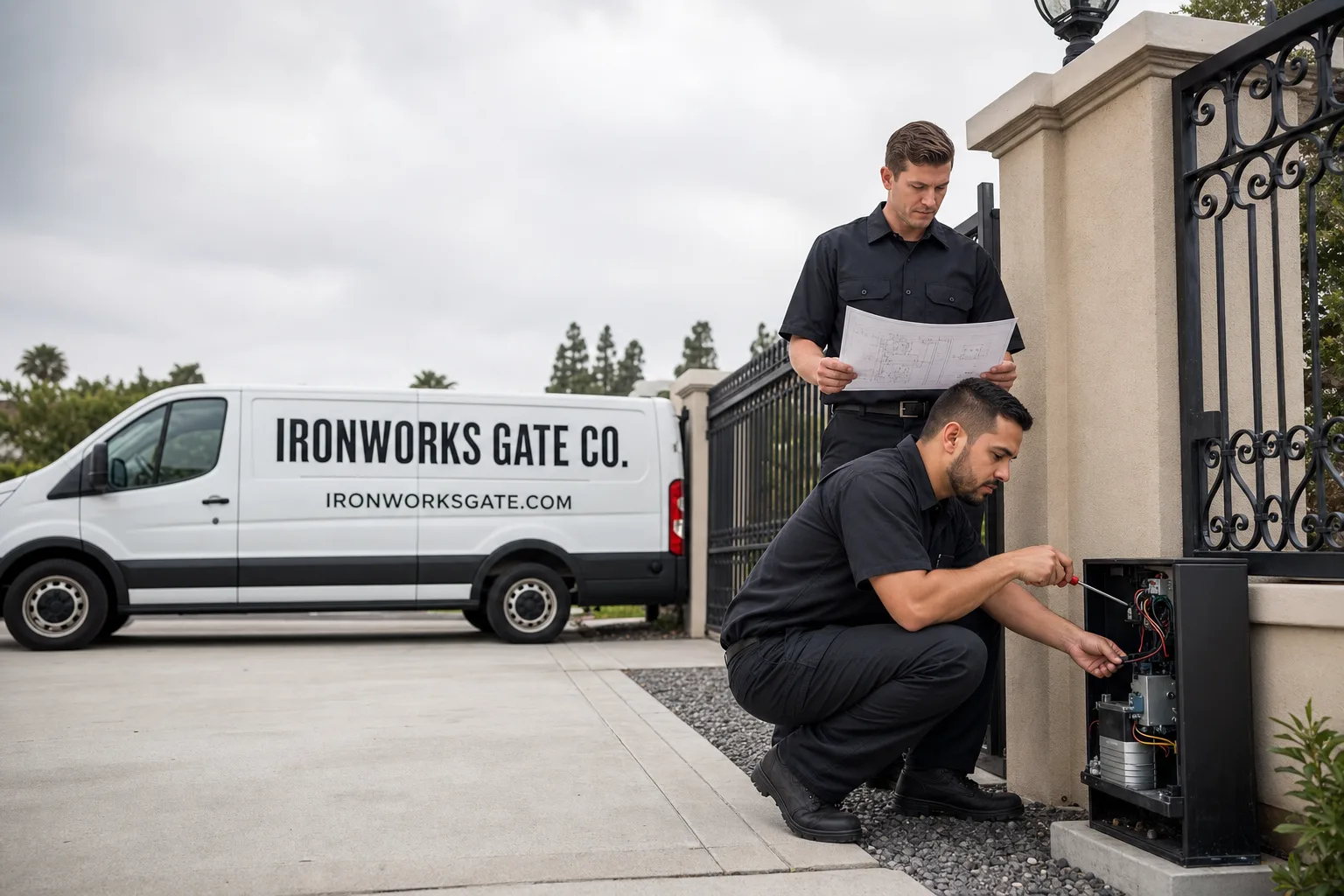
When your local Ironworks Gate Co. technician arrives, the first thing they do is watch the gate run a full cycle. That single observation usually narrows the cause to one or two possibilities before a tool comes out of the bag.
From there, the technician checks the operator’s timer and control settings, tests each safety sensor for alignment and signal integrity, inspects the limit switches for wear or movement, and reads any fault codes stored in the control board. Ironworks is trained and equipped to service nine gate-automation brands – LiftMaster, FAAC, BFT, Linear, Viking, Ghost Controls, DoorKing, Elite, and Mighty Mule – so whatever is sitting at the end of your driveway, the correct diagnosis gets made without guesswork.
Most of these repairs fall under our Gate Repair service and are completed in a single visit. Before any work begins, you receive a written estimate with the full price spelled out. No surprises on the bill. Every completed repair is backed by the 90-Day Done Right Promise: if it is not right, we come back and make it right – no paperwork, no arguing, no exceptions. That is the Keystone Standard, and it applies to every job.
Frequently Asked Questions
Yes, it can be. A gate closing without warning or command can strike a vehicle, a person, or a pet – and a residential gate carries enough force to cause serious injury or property damage. Until the cause is found and corrected, treat the gate as unpredictable, keep children and animals away from the opening, and call for service rather than trying to live around the problem. Call (833) 754-7503 and a live person will pick up, any hour of the day.
It should not wait. A gate that closes unexpectedly is a safety and liability problem, not just an inconvenience, and the underlying cause – a failing limit switch, a deteriorating control board, damaged wiring – tends to get worse rather than better on its own. The sooner the fault is identified, the less likely it is to take out additional components. Call (833) 754-7503 to get your local team on the schedule.
In most cases, yes. Your local Ironworks Gate Co. team works to get to urgent gate problems as quickly as scheduling allows, and our phone line is answered by a live person 24 hours a day, 7 days a week – not a voicemail, not a callback queue. Call (833) 754-7503 right now and tell us what the gate is doing; we’ll tell you exactly when we can be there.
Most cases of a gate closing on its own are resolved by repairing or adjusting the existing operator – replacing a limit switch, correcting a sensor, resetting or replacing a control board – rather than replacing the entire unit. After the technician diagnoses the fault, you receive a written estimate that spells out both the repair cost and, if replacement is the better long-term answer, what that would look like. You decide from there, with no pressure either way.
Get It Fixed
Call (833) 754-7503 any time – a live person answers around the clock. You can also book online. Your local Ironworks Gate Co. team will diagnose the fault, give you a written estimate before any work starts, and back the completed repair with our 90-Day Done Right Promise.
Written by Victor Salinas, Owner at Ironworks Gate Co., serving local communities across the country since 1984.