
Gate Reverses Immediately
What’s Happening
When a gate starts moving and then immediately reverses direction without completing the cycle, the operator has detected something it interprets as an obstacle or a fault condition, and it stops itself on purpose. In most cases, the culprit is a misaligned or obstructed safety sensor, an out-of-adjustment limit setting, or a problem with the motor’s internal logic that’s telling the drive to stop before it should.
The gate isn’t broken in a dramatic sense. It’s doing what it was programmed to do – protect itself and anything standing in its path. But something in that protective loop is now reading the situation wrong, and until that’s corrected, the gate will keep reversing every single time. The good news is that this is one of the more diagnosable gate problems there is, because the symptom itself points directly at a short list of causes. Here’s how to narrow it down before a technician arrives.
Why It Happens
Safety Sensor Misalignment or Obstruction
Most automatic gates use photoelectric or contact sensors to detect obstacles in the gate’s path. If those sensors are even slightly out of alignment – pointing past each other instead of at each other – the operator reads a constant “blocked” signal and reverses the moment travel begins. Cobwebs, dirt buildup, a shifted mounting bracket after a rainstorm, or a shrub that’s grown a few inches into the beam path can all trigger this. Look at the sensor eyes on both sides of the gate opening. If one indicator light is blinking, off entirely, or a different color than normal, misalignment is likely your cause.
Obstruction or Pressure Limit Set Too Sensitive
Gate operators have an internal setting called an obstruction sensitivity or force limit – it controls how much resistance the motor will push through before it decides it’s hit something and reverses. Over time, these settings drift, especially after a power surge, a firmware reset, or a recent installation of new gate hardware that changed the load on the drive. If the gate reverses immediately but the sensors look clean and properly aligned, a technician can test the force setting in a few minutes. Don’t try to adjust this yourself on a heavy estate gate or any slide gate on a rail – a force limit set too high can cause the gate to push through a real obstruction, which creates a safety hazard in the other direction.
Physical Obstruction on the Track or Hinge
A slide gate that hits a stone, a root heave, or a rail that has shifted over a winter will reverse the instant it meets that resistance. A swing gate with a hinge that’s seized, a post that’s settled, or a ground stop bolt that’s been knocked out of position does the same thing. Walk the full travel path of your gate – the entire track for a slider, the full swing arc for a hinged gate – and look for anything that shouldn’t be there. If you find physical damage to the frame, the rail, or the hinges, stop using the gate and call. Forcing a structurally compromised gate risks bending the frame, shearing a motor shaft, or snapping a drive arm.
Operator Logic Fault or Controller Issue
Sometimes the reversal has nothing to do with sensors or obstructions. The control board inside the operator has stored a fault code from a power spike, a low battery backup, or a corrupted cycle count, and it’s refusing to complete the travel cycle until that error is cleared. If your gate reverses on the very first inch of movement with no warning, no visible obstruction, and sensors that appear fine, a controller fault is worth suspecting. Some operators will blink an error code on their status light – count the blinks and check the manual if you have it. That code tells a technician exactly where to start.
What to Do Right Now
- Stop cycling the gate. Every reverse cycle under a fault condition puts unnecessary strain on the motor and the drive mechanism. Running it repeatedly won’t clear the problem, and it may deepen one.
- Check the sensor eyes. Look at both photoelectric eyes in the gate opening. Are both indicator lights on and steady? If one is off or flashing, gently wipe the lens face with a dry cloth and see if the light stabilizes. Don’t force or reposition the mounting bracket yourself – that’s a calibration step for the technician.
- Walk the full travel path. Look for stones on the track, overgrown vegetation in the swing arc, pooled water or ice at the base of a sliding gate, or a gate post that’s visibly shifted. If you find a physical obstruction you can remove safely – a fallen branch, a stone – remove it. If the gate frame itself is bent or the rail is damaged, don’t touch it further.
- Take a short video. Record one reverse cycle from a safe distance. This is genuinely useful to the technician – seeing where in the travel arc the reversal happens narrows the diagnosis before they even open the control panel. Keep your distance from the gate during this step.
- Note any recent changes. Heavy rain, a recent power outage, a vehicle that bumped the gate, a landscaping crew that was working near the sensors – any of these are worth mentioning when you call. That context often cuts the diagnostic time in half.
How We Fix It
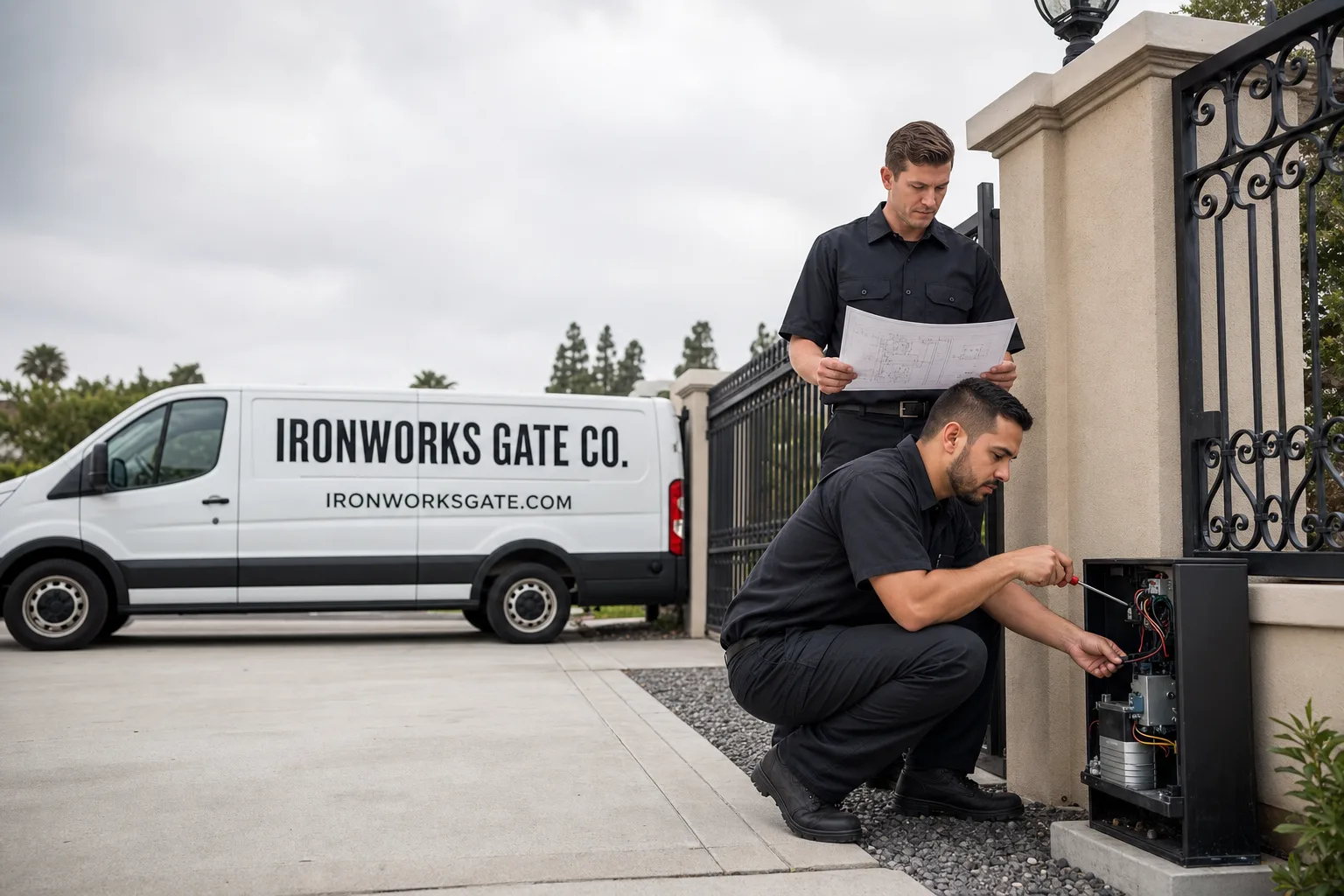
When your local Ironworks Gate Co. technician arrives, the first thing they do is run a full diagnostic cycle – watching the gate move and noting exactly where and how the reversal happens. From there, the path splits quickly. If it’s a sensor issue, they’ll test beam alignment, clean the optics, and recalibrate the mounting to factory spec. If it’s a force limit problem, they’ll test the operator under load and adjust the sensitivity setting to the correct range for your gate’s actual weight and travel. Physical obstructions on a track or hinge get addressed through our gate repair and gate parts and welding services – whether that means resetting a ground stop, re-welding a shifted bracket, or straightening a bent section of rail. Controller faults get diagnosed against the fault log, and if a board needs replacement, that’s quoted in writing before the part is touched. Most jobs of this type are completed in a single visit. Before any work begins, you’ll have the price in writing – no surprises on the bill. Every repair is covered by the 90-Day Done Right Promise: our written, no-arguing Keystone Standard. If it’s not right, we come back and make it right.
Frequently Asked Questions
It can be, depending on the cause. A gate reversing due to a sensor fault means the safety system designed to protect people and vehicles is no longer working as intended – the gate might complete a full close cycle in a situation where it should stop. A gate reversing due to a structural problem like a bent rail or a seized hinge can also cause sudden, unpredictable movement if you keep forcing it. Stop using the gate for full automated cycles and call (833) 754-7503 – a live person is available right now, around the clock.
If the gate is your primary entry point, or if you have young children or pets on the property, don’t wait. A gate stuck in a reversal loop leaves your property either open or inaccessible depending on where in the cycle it fails. If you have a secondary entrance you can use safely, the gate won’t get worse from sitting overnight – but it also won’t fix itself. Call (833) 754-7503 and we’ll tell you honestly how urgent it is once we understand what you’re seeing.
Call us at (833) 754-7503 and we’ll connect you directly with your local Ironworks Gate Co. team – a live person answers every call, any hour, seven days a week. We’ll let you know what’s available in your area and get you scheduled as quickly as possible. We won’t make you leave a voicemail and wait.
That depends on the cause, and we won’t quote you a number before a technician can see the gate and identify exactly what’s wrong. What we will do is give you a written estimate before anything is touched – the price for your specific job, in writing, so you can decide before any work begins. If your repair comes to more than $250, our $50 Off Any Repair Over $250 offer applies automatically. And if you’ve already received a written estimate from another company, we’ll provide a free second opinion at no charge.
Get It Fixed
Call (833) 754-7503 right now and a live person will answer – not a voicemail, not a queue. Your local Ironworks Gate Co. team will diagnose the reversal, give you a written estimate before anything starts, and get the gate working the way it should. We’ve been doing this since 1984, and we stand behind every job.
Written by Victor Salinas, Owner at Ironworks Gate Co., serving local communities across the country since 1984.